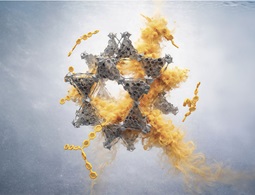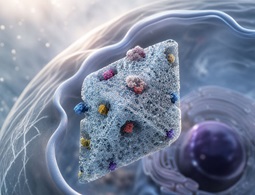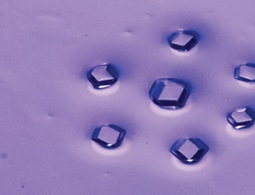
Locked MOFs are the key to high porosity
Sophisticated geometry design gives rise to a new form of crystalline material.
Sophisticated geometry design gives rise to a new form of crystalline material.
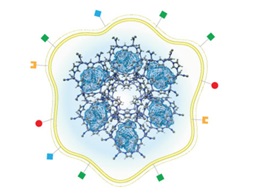
An antibody loaded onto a porous metal organic framework is released by the acidic environment that surrounds tumors, avoiding the adverse effects of administering the antibody alone.
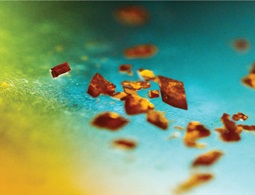
A reverse form of host-guest chemistry could upend the way the chemical industry approaches challenging, energy-intensive molecular separations.
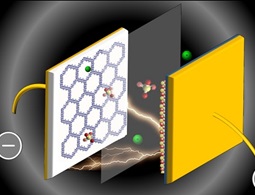
Carefully designed covalent organic frameworks could make supercapacitor electrodes that have a greater ability to store electric charge.
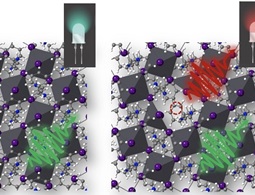
Chemical treatments enable low-cost light sources to emit specific colors on demand.
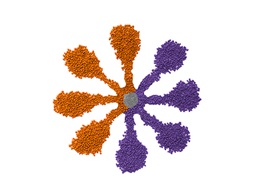
Unique star-shaped polymers have highly tunable properties that will open up a range of new applications.
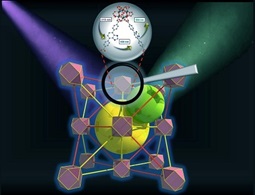
An energy transfer process that mimics photosynthesis could help to extract more power from sunlight.
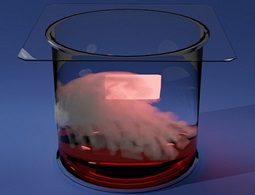
A facile and mild bromine treatment eliminates surface and bulk defects from perovskites to boost the materials’ optoelectronic properties.
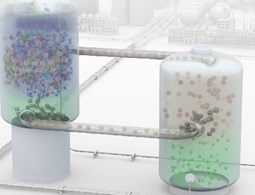
A molecule with a hollow center proves ideal for separating a common industrial chemical mixture.
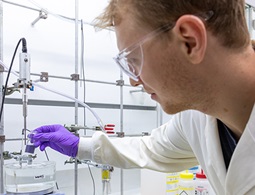
More efficient photocatalysts could unlock the potential of solar energy.
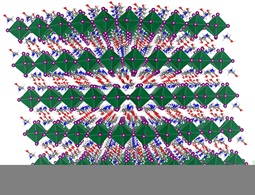
Materials that can slow the cooling of highly energetic hot carriers could capture extra energy from the Sun.
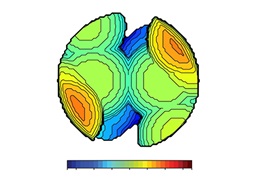
Mapping the three-dimensional structure of catalytic centers helps to design new and improved catalysts.