

When autocomplete results are available use up and down arrows to review and enter to select.
Filters 1
Clear filters
Date
Categories
Topics
- Applied Mathematics and Computational Sciences 0
- Applied Physics 0
- Artificial Intelligence 0
- Awards & Recognition 0
- Bioengineering 0
- Bioscience 0
- Chemical Engineering 0
- Chemistry 0
- Computer Science 0
- Coral 0
- Earth Science and Engineering 0
- Electrical Engineering 0
- Energy 0
- Energy Resources and Petroleum Engineering 0
- Environmental Science and Engineering 0
- Food 15
- Health 1
- Marine Science 0
- Material Science and Engineering 0
- Mechanical Engineering 0
- Plant Science 1
- Press Release 0
- Red Sea 1
- Statistics 0
- University 0
- Water 2

Electronic sensor detects early Parkinson’s markers in blood
Sensor technology developed by KAUST and Oxford detects Parkinson’s-related molecular signals in blood, achieving 90 percent accuracy in an initial clinical study
From discovery to impact: KAUST translating research into real-world solutions
KAUST is expanding its research translation capabilities with new translational faculty, targeted funding, hands-on technology development, and industry partnerships to move promising discoveries toward real-world applications and impact in Saudi Arabia and beyond.
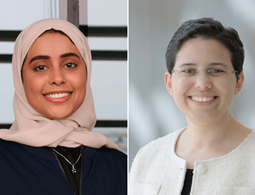
Two KAUST graduates receive MIT–KACST Ibn Khaldun Fellowship
Two KAUST graduates, Rawan Alghamdi and Banan Alhazmi, have been awarded the MIT–KACST Ibn Khaldun Fellowship for Saudi Arabian Women. At MIT, Rawan will advance next-generation wireless communications, while Banan will research polymeric membranes for more energy-efficient gas separations.
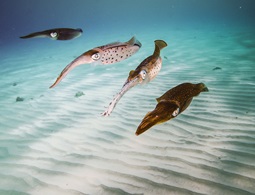
Sustainable seafood sources could help close global nutrition gaps
Aquatic invertebrates are rich sources of essential nutrients and could contribute to global nutrition security if sustainably managed.
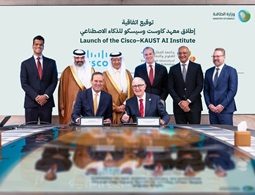
Cisco–KAUST AI Institute launches research into AI networks, data centers, and digital twins
The Cisco–KAUST AI Institute has launched its first collaborative research projects, advancing AI for data centers, smart-city networks, digital twins, and precision agriculture while strengthening AI research, talent, and infrastructure in Saudi Arabia.
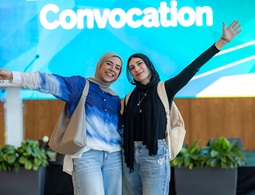
Bold ambitions, bright future: KAUST welcomes new students
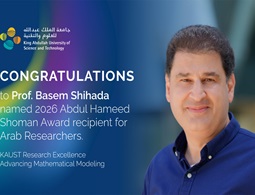
Shoman Award win for Professor Basem Shihada highlights excellence in Arab-led science

KAUST and HUMAIN collaborate on cloud-based high-performance computing
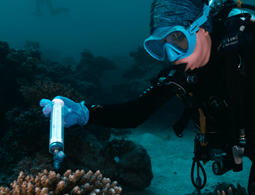
Microbial therapies improve heat-stressed coral health
During a natural Red Sea heat wave, KAUST researchers found that probiotic and postbiotic microbial therapies improved heat-stressed coral health. The research could support more scalable approaches to strengthening coral resilience and conservation.
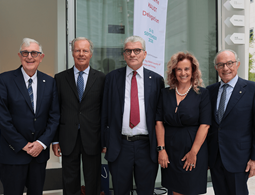
KAUST, Milano-Bicocca, and Bicocca Foundation partner to advance research and innovation
KAUST, the University of Milano-Bicocca, and Bicocca Foundation have formed a new partnership to advance research, education, and innovation across shared priorities including AI, health, sustainable energy, climate change, biotechnology, and food systems.
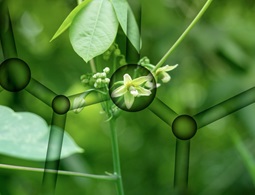
New gene insertion method for plant engineering
By adapting a natural genetic element, researchers insert large genes into tobacco and rice.
Global study reveals hidden nutritional value of shellfish and other Ocean Foods
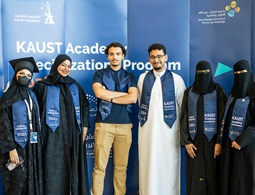
KAUST Celebrates 290 Graduates of Specializations Program, Strengthening Saudi Expertise in Technology
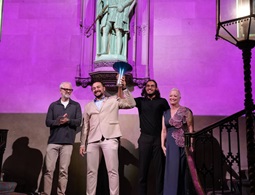
Flow Guard wins the US$1 million Hult Prize
Flow Guard Solutions, a KAUST-developed water management startup co-founded by Mohammed Ahmed and Omar Khalifa, won the 2026 Hult Prize and its US$1 million grand prize, rising above 18,000 teams worldwide and highlighting KAUST and Saudi Arabia’s growing innovation impact.
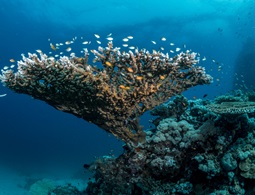
Corals show ‘vaccine-like’ responses after pathogen exposure
Exposure to cells from a coral pathogen appears to prime corals to respond more effectively to future infections.
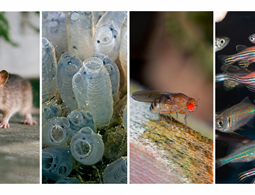
Tracing 700 million years of cell evolution
A new AI tool helps identify hidden similarities across distant species.
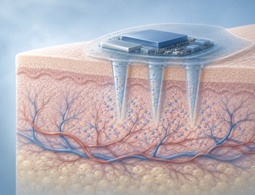
Wearable microneedle patch could improve drug monitoring
A wearable patch with microneedles coated in DNA molecules tracks levels of antibiotics in the body in real time.
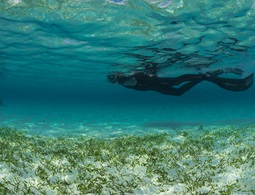
Climate finance could unlock investment in seagrass restoration

Smoothing the math of spatial networks
A new statistical approach could make modeling spatial networks more accurate and efficient.

Virtual reality headsets open a window into the mind
AI models can use data from motion sensors to infer what users perceive, but the research reveals privacy risks.