

Two KAUST graduates receive MIT–KACST Ibn Khaldun Fellowship
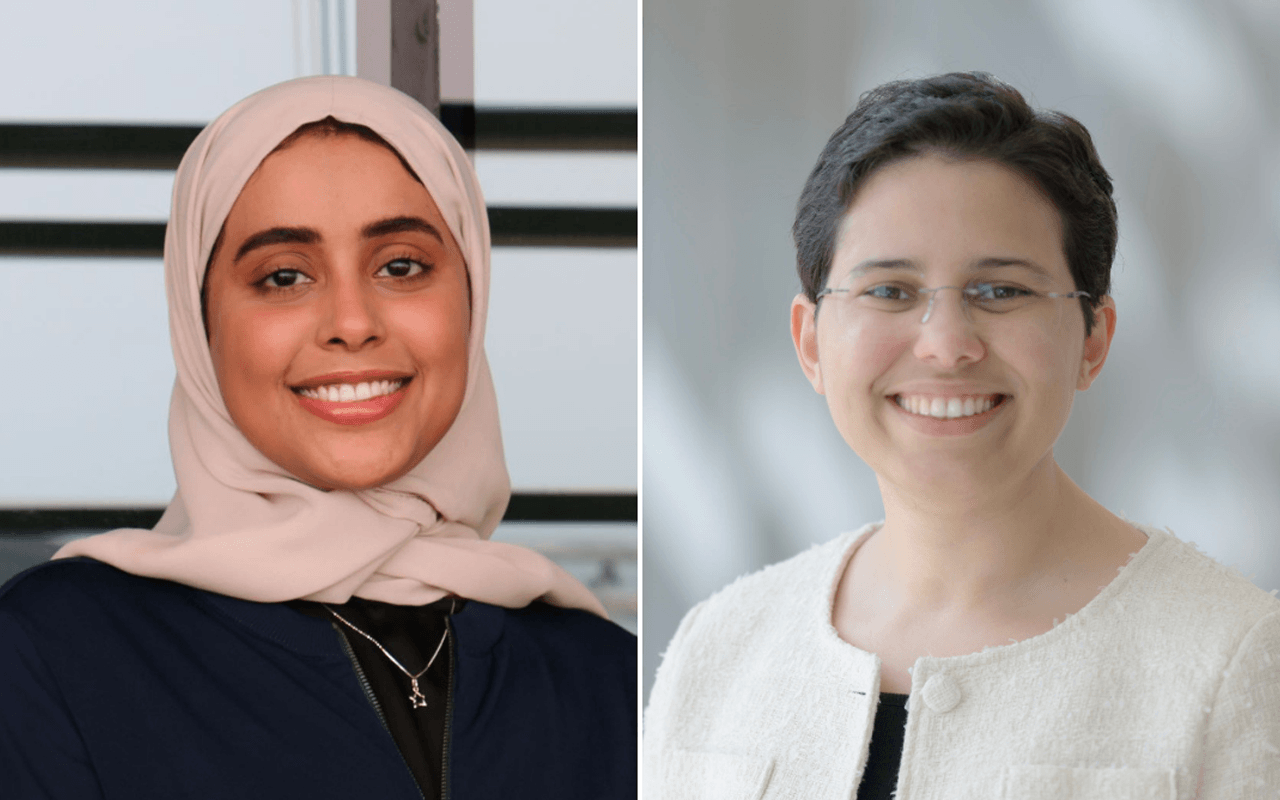
Banan Alhazmi, left, and Rawan Alghamdi have been awarded the MIT–KACST Ibn Khaldun Fellowship for Saudi Arabian Women.
Not one, but two King Abdullah University of Science and Technology (KAUST) graduates have received the prestigious MIT–KACST Ibn Khaldun Fellowship for Saudi Arabian Women — an honor highlighting the growing international profile of Saudi women in science, technology, engineering, and mathematics (STEM).
“Receiving this fellowship is particularly meaningful to me because I had known about the program since I was an undergraduate and had watched several Saudi women I admired receive it,” said Rawan Alghamdi, who finished her Ph.D. in August. The fellowship marks the next stage in her research, which she began at KAUST, to extend reliable wireless connectivity beyond the limits of conventional cellular networks.
Alghamdi learned of her fellowship acceptance while in Riyadh, where she was teaching Saudi undergraduate students the fundamentals of artificial intelligence and deep learning as an instructor in the KAUST Academy AI specialization program. “I had to read the email three times to believe I got the fellowship,” she said.
Banan Alhazmi, who earned a Ph.D. in environmental science and engineering, said receiving the fellowship is a privilege and praised the opportunities it provides Saudi women to pursue their ambitions. “I hope I can share what I learn from this experience and, in turn, help create similar opportunities for other women in STEM.”
KAUST’s pivotal role
The competitive MIT–KACST Ibn Khaldun Fellowship for Saudi Arabian Women supports outstanding Saudi women pursuing advanced research at the Massachusetts Institute of Technology (MIT). Alghamdi and Alhazmi are pursuing postdoctoral research in next-generation wireless communications and membrane science, respectively.
Alghamdi said the achievement reflects KAUST’s broader role in supporting students’ research ambitions. “KAUST creates an environment in which students are encouraged to build international collaborations and pursue opportunities beyond the University, while remaining connected to a strong alumni and faculty network.”
In addition to the inspiration and mentorship she received from many KAUST faculty and alumni, Alghamdi credits Al-Khawarzmi Distinguished Professor Mohamed-Slim Alouini and Professor Tareq Al-Naffouri, both electrical and computer engineering faculty, with shaping her approach to research and academia.
“They encouraged me to pursue collaborations, present my work internationally, and prepare intentionally for an academic career.”
Prior to earning her Ph.D., Alhazmi was a chemical engineering master’s student at KAUST. She said Professor Suzana Nunes’ mentorship helped shape her growth as a researcher and woman in science. Alhazmi also credits co-supervisor Professor Gyorgy Szekely with encouraging her growth as an independent researcher. “KAUST played a pivotal role in preparing me for this opportunity,” she said.
Membrane materials that matter
Focusing on developing precise membranes that can separate molecules and gases using less energy than many conventional industrial processes, Alhazmi hopes her research could improve the sustainability and efficiency of key sectors in Saudi Arabia, including energy, water, and chemicals.
At MIT, Alhazmi is working with Professor Zachary Smith’s group on polymeric membranes for gas separations. Following her fellowship, Alhazmi hopes to apply the knowledge and experience gained at both KAUST and MIT to contribute to the Kingdom’s growth and vision.
“I'm particularly interested in the energy sector and hope to play a role in advancing the energy transition and supporting the development and deployment of new technologies.”
Improving wireless networks
With plans to improve how non-terrestrial wireless networks receive signals, Alghamdi’s MIT research aims to investigate energy-efficient signal-processing techniques to provide affordable, efficient connectivity to more users and extend coverage to hard-to-reach areas.
The work could support broadband and connected devices in remote areas while providing resilient communications when terrestrial infrastructure fails, Alghamdi said, capabilities particularly relevant to Saudi Arabia. “At MIT, I want to broaden that perspective by designing universal decoding techniques that are compatible with different coding approaches while maintaining low cost and energy efficiency.”
Alghamdi will work with Professor Muriel Médard’s group at MIT. She hopes to return to Saudi Arabia as an assistant professor and establish a research group focused on future wireless communication systems. She plans to develop reliable connectivity for satellite, high-mobility, and other challenging communication environments.
Saudi women empowered
Prior to her Ibn Khaldun Fellowship selection, Alhazmi received the 2025 EMS Best Paper Award for developing highly selective membranes to separate active pharmaceutical ingredients in organic solvents. The research, a major part of her Ph.D., took years to develop, making the recognition particularly meaningful at this stage of her career.
Alghamdi was recently named a rising star on the 100 Brilliant and Inspiring Women in 6G™ 2026 list.
“Many Saudi women are now conducting internationally competitive research across universities, research institutions, and industry,” she said, adding that young students now have more examples of scientific careers they can pursue. “I strongly believe visibility and representation matter, and I hope my path can be one of those examples for younger students.”
Their recognitions highlight KAUST’s role in developing Saudi research talent that contributes to the national and global research communities, as well as the growing international profile of Saudi women in science and engineering.