

Google’s top results: KAUST student earns prestigious Ph.D. fellowship
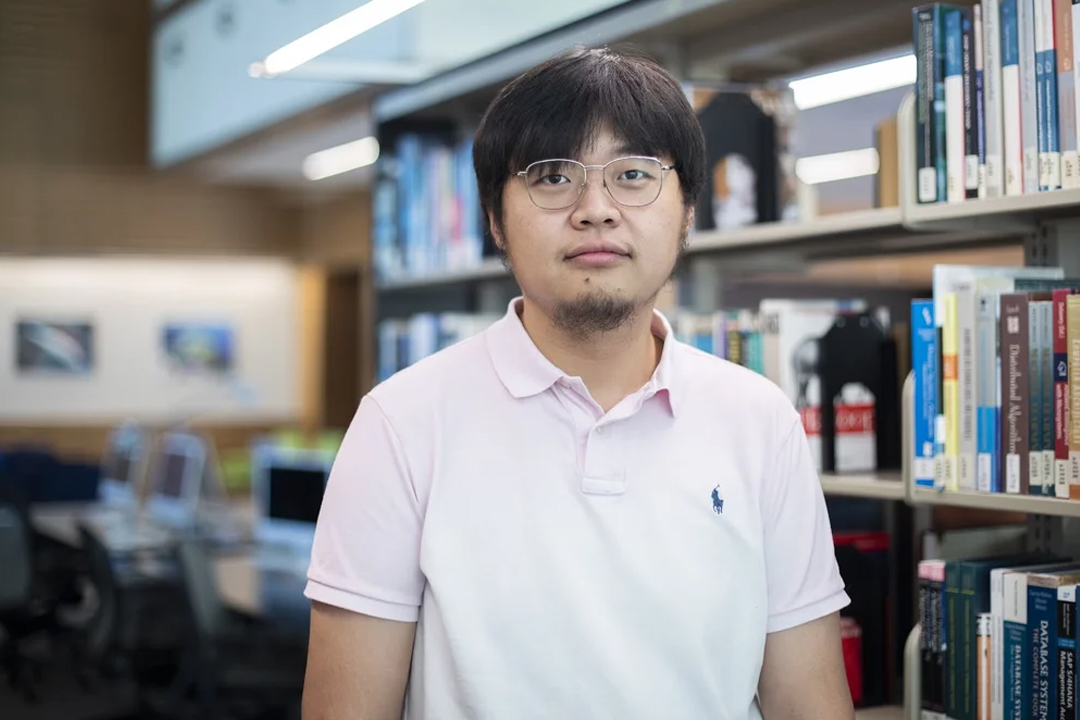
KAUST Ph.D. candidate Wenyi Wang is receiving the 2026–27 Google PhD Fellowship.
It does not take an advanced algorithm to find King Abdullah University of Science and Technology (KAUST) students receiving global recognition for their research.
Wenyi Wang, a KAUST Ph.D. candidate in computer science, has earned the 2026–27 Google PhD Fellowship in Machine Learning and ML Foundations. The fellowship connects recipients with Google’s broad research community.
“I’m very excited that the fellowship recognizes my research on recursively self-improving artificial intelligence and supports its continuation during my Ph.D. at KAUST,” Wang said, adding that the fellowship provides financial support and access to a Google Research mentor whose feedback will complement his supervision at KAUST. “It contributes to a research direction I have been pursuing for several years.”
Working under the supervision of Professor Jürgen Schmidhuber, co-chair of the KAUST Center of Excellence for Generative AI, Wang’s academic interests share a common thread: developing artificial general intelligence through systems that can learn to improve themselves over time.
“My particular focus is the recursive effect of self-modification,” Wang said. “When a system changes itself, the modified system participates in producing later changes. A modification can therefore change how the system improves itself, how it subsequently changes that improvement process, and so on. I want to understand, measure, and optimize these effects — not simply produce a succession of better task solvers.”
KAUST provides Wang with a setting to turn foundational ideas into working systems, along with computational resources to support their development. Schmidhuber’s self-improving machines work provided a direct intellectual foundation for Wang’s research, while Professor Peter Wonka’s recommendation supported his fellowship application.
“Research supervision and faculty support also helped me develop the agenda and materials behind the fellowship application,” Wang said. His 2026–27 Google PhD Fellowship selection highlights the quality and global relevance of research being pursued by KAUST students and the University’s ability to develop emerging research talent.
His recognition follows KAUST Ph.D. candidate in statistics Kaja Gruntkowska’s selection for the fellowship last year in the Algorithms and Optimization category. Together, their selections demonstrate a growing pipeline of KAUST researchers whose work is being recognized by leading global organizations.
Wang ultimately hopes to understand and build intelligence computationally, with a hypothesis that recursive self-improvement is a necessary ingredient. At KAUST, with support from Google.org through the Google PhD Fellowship, he aims to develop the theoretical foundations and practical algorithms for systems that improve their own learning and self-modification procedures, with the effects of those changes carrying forward into subsequent self-modifications.
“The long-term objective is to understand how to make this recursive process produce sustained advances in general intelligence, rather than isolated improvements on particular tasks,” Wang said.