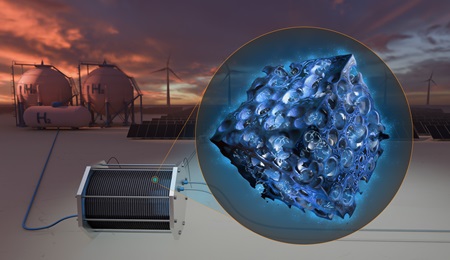
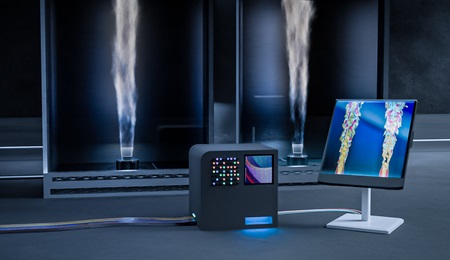
KAUST mechanical engineers have developed a simple and cost-effective method for modeling the combustion characteristics of gasoline, which could help to identify fuel mixtures with high octane numbers.© 2020 KAUST
A simple, fast and inexpensive method for modeling the combustion characteristics of gasoline has been developed by KAUST researchers, paving the way for cleaner and more efficient transport fuels.
The combustion of hydrocarbon-based fuels for transportation is a significant contributor to climate change, prompting the need for cleaner, better-performing fuels. Gasoline—the most commonly used fuel in cars—contains hundreds of hydrocarbons and, depending on its composition, has a wide range of combustion characteristics.
One indicator of a fuel’s performance is the octane number: the higher the number, the more the fuel can be compressed during ignition and the more efficient is its combustion. However, physically measuring the octane rating for gasoline is complicated, expensive and time-consuming.
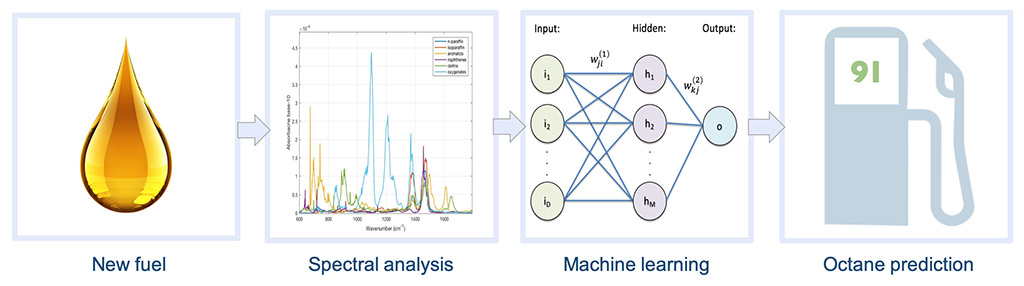
The workflow involves taking a new fuel to the infrared spectra and applying machine learning to perform an octane prediction.
© 2020 KAUST
Now, Aamir Farooq and Emad Al Ibrahim from KAUST’s Clean Combustion Research Center have developed a simple and cost-effective method for modeling the combustion characteristics of gasoline, which could help to identify fuel mixtures with high octane numbers.
“Our model offers a quick and easy method for screening fuel mixture candidates without the need for physical testing,” says Al Ibrahim. “Researchers can use our model to theorize a new fuel blend and then estimate what its octane number would be.”
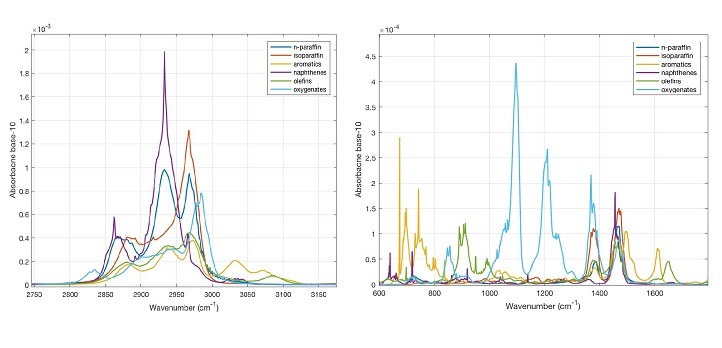
Spectra of the main chemical families in gasoline.
Reproduced with permission from reference one © 2020 Australian Chemical Society
The researchers built a data set comprising infrared spectra, octane numbers and molecular properties for the main components of gasoline, including paraffin, isoparaffin, olefin, naphthene and aromatic hydrocarbons. From this, they produced composite spectra for 148 different hydrocarbon blends.
Using a nonlinear statistical model, they extracted the most relevant information from the spectra. They then transformed this data into scores that relate to the chemical features of the fuel, allowing them to predict its octane number.
“The use of nonlinear methods for analyzing spectra is important because hydrocarbon molecules tend to exhibit synergistic and antagonistic blending,” explains Al Ibrahim. “For example, a mixture of two fuels can often produce an octane number that is higher than that of the individual constituents.”

Aamir Farooq (back) and Emad Al-Ibrahim discuss the accuracy of their prediction workflow.
© 2020 KAUST
By simulating the spectra for 38 FACE (fuels for advanced combustion engines) gasolines, the model was able to accurately predict their octane numbers, providing a method for determining the combustion characteristics of different fuel mixtures.
“As we look to find newer and cleaner fuel formulations, we need to be able to quickly screen potential candidate fuels: low-carbon refinery blends, biofuels, solar fuels and e-fuels. We can now do this easily, cheaply and rapidly,” says Farooq.
References
-
Al Ibrahim, E. & Farooq A. Octane prediction from infrared spectroscopic data. Energy Fuels 34, 817-826 (2019).| article