

When autocomplete results are available use up and down arrows to review and enter to select.
Filters 1
Clear filters
Date
Categories
Topics
- Applied Mathematics and Computational Sciences 0
- Applied Physics 0
- Artificial Intelligence 0
- Awards & Recognition 0
- Bioengineering 0
- Bioscience 0
- Chemical Engineering 0
- Chemistry 0
- Computer Science 0
- Coral 0
- Earth Science and Engineering 0
- Electrical Engineering 0
- Energy 0
- Energy Resources and Petroleum Engineering 0
- Entrepreneurship 1
- Environmental Science and Engineering 0
- Food 0
- Health 0
- Marine Science 0
- Material Science and Engineering 0
- Mechanical Engineering 0
- Plant Science 0
- Press Release 0
- Red Sea 0
- Statistics 0
- University 0
- Water 0
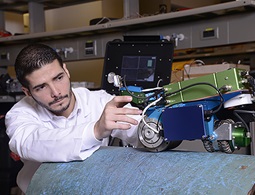
KAUST graduates lead the way in Saudi Aramco’s robotic research

Relax! High-resolution imaging reveals atomic structure of an important plant stress factor
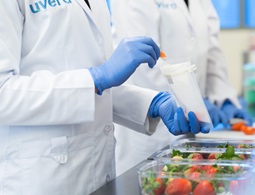
Double treatment stores salmon and strawberries for later
Combining UV sterilization with vacuum sealing significantly extends the shelf-life of a variety of foods.
Memory formed alongside brain signaling system
Evolution of lactate-mediated nerve signaling probably enabled memory systems, a comparative gene study shows.

Sensing water for smarter agriculture
MOF-based soil moisture monitoring device a step toward precision irrigation.

Upcycled plastic membrane helps clean up waste
Plant-derived biosolvents enable the sustainable conversion of plastic waste into valuable membrane materials.

A machine that learns to learn
A neural network that can learn its own learning algorithm opens the door to self-improving artificial intelligence.

Fastening enzyme seals the deal in genome repair
Structural biology study reveals dynamics of DNA ligation during genome replication.

Simple means to a clear view
The image of an object that is obscured when the light passes through a scattering material can be recovered in real time.

Modeling complex faults on the Sinai-Arabia plate boundary
Detailed 3D simulations of the Lebanon Restraining Bend will enhance understanding of fault structures and associated seismic activity.
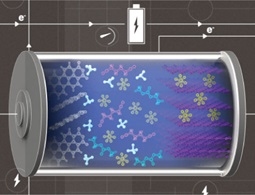
Metal-free batteries raise hope for more sustainable and economical grids
Ammonium-ion electrolytes could help create ecofriendly and sustainable alternatives to lithium-ion batteries, particularly for grid storage.
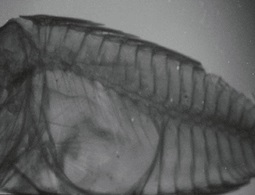
Organic X-ray excitement for innovative imaging
Screens fabricated from organic materials show promise for improved X-ray imaging for medical and security settings.

Understanding how gas evolves could help the transition from fossil fuels
A novel modeling technique provides valuable insights into the maturation of oil and gas in the Tuwaiq Mountain shale formation.

Laser imaging helps clean fuels live up to their reputation
Using ammonia as a hydrogen-rich energy source requires technology that can spot pollutants in flames.
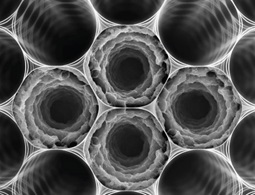
Self-assembled power
Rechargeable batteries to benefit from the development of lithium-loving foams.
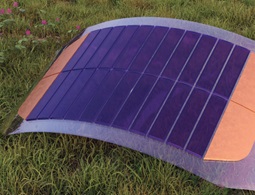
Enhancing organic solar cells’ green glow
Environmentally friendly renewable biosolvents could help clean up the manufacture of solar panels.

DNA replication in humans proves slow off the mark
Textbook model of lagging-strand synthesis may be too simplistic for human DNA.
A new spin on bouncing sound waves
Insight into the spinning-induced scattering of sound could help create next-generation acoustic devices using new phonon modes.

Northern Red Sea reefs resist bleaching in warming seas
While corals die out worldwide, resistant reefs in the northern Red Sea could endure a dire global warming scenario.