Biomedical Sciences Division (BioMed)
Decoding Life, Advancing Health
Decoding Life, Advancing Health

The Biomedical Sciences (BioMed) division at KAUST brings together world-class science, technology, and education to address today’s most pressing health challenges. Through interdisciplinary research, advanced computational and digital tools, and strong partnerships across the healthcare ecosystem, BioMed connects discovery with real-world impact - supporting national priorities while contributing to global advances in health and disease.
BioMed will improve health in Saudi Arabia and beyond by harnessing cutting edge science and technology to investigate, educate on, and translate discoveries that make people’s lives better.
BioMed applies the scientific and technical expertise of KAUST by interdisciplinary collaboration and intersectional partnerships both within and beyond the university, leveraging and boosting the efforts of the health care ecosystem to understand, prevent, and treat disease.
We will encourage, educate, and promote expertise in the study and taming of disease to help engineer a healthier life for all, using knowledge generation with widespread deployment of health-translated advances underpinned by our cutting edge, world class technical expertise.
BioMed is KAUST's newest division, harnessing the University's world-class science and technology to advance healthcare outcomes in Saudi Arabia and beyond. We apply cutting-edge computational and digital tools to understanding, combating and preventing disease.
BioMed is at the start of an exciting journey. The division offers a collaborative environment where scientific excellence meets a passion for teaching and mentoring a new generation of graduates who will advance health in the 21st century.
Our priorities are those of the Kingdom, our mission aligned with Vision 2030's aspirations for better health. Our graduate programs uniquely integrate biology with engineering and bioinformatics and, our faculty and students strive to be future-ready for the rapidly emerging challenges and opportunities in biomedical science.
BioMed draws on the KAUST ecosystem of outstanding research and technical capabilities, all set against the backdrop of the Red Sea. We are beginning an ambitious journey, and invite those who share our vision of a healthier life for all.
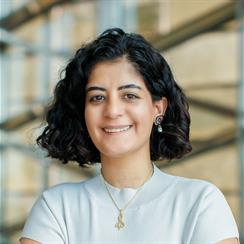
By exploring the developmental, synaptic, and circuit mechanisms of sensory perception, we strive to uncover new insights into how the brain functions and how its disruption contributes to neurodevelopmental disorders
Professor Leena Ali Ibrahim leads the Neurocircuits Lab investigating how sensory experience and development shape inhibitory circuits in the brain. She earned her Ph.D. in Neuroscience from the University of Southern California, U.S., and completed postdoctoral training at Harvard Medical School, U.S., where she studied the development and function of cortical circuits. In 2022, she was named a Next Generation Leader by the Allen Institute, recognizing her as one of a distinguished group of early-career neuroscientists guiding cutting-edge research in brain science.
Professor Leena Ali Ibrahim’s research focuses on how neural circuits develop, adapt, and function to shape sensory perception and behavior. Her lab investigates the role of inhibitory neurons, particularly in cortical layer 1, in integrating sensory input with internal brain states across development and in models of neurodevelopmental disorders. She combines molecular profiling, in vivo imaging, optogenetics, and computational tools to dissect the cellular and circuit-level mechanisms underlying experience-dependent plasticity.

Postdoctoral Fellow, Department of Neurobiology, Harvard Medical School,2021
Ph.D Neuroscience, University of Southern California, Los Angeles, 2016
M.Sc Life Sciences, Jawaharlal Nehru University, New Delhi, 2008
B.Sc Biomedical Sciences, University of Delhi, New Delhi, 2006