

Nanoscale drug factory helps cells make medicine from within
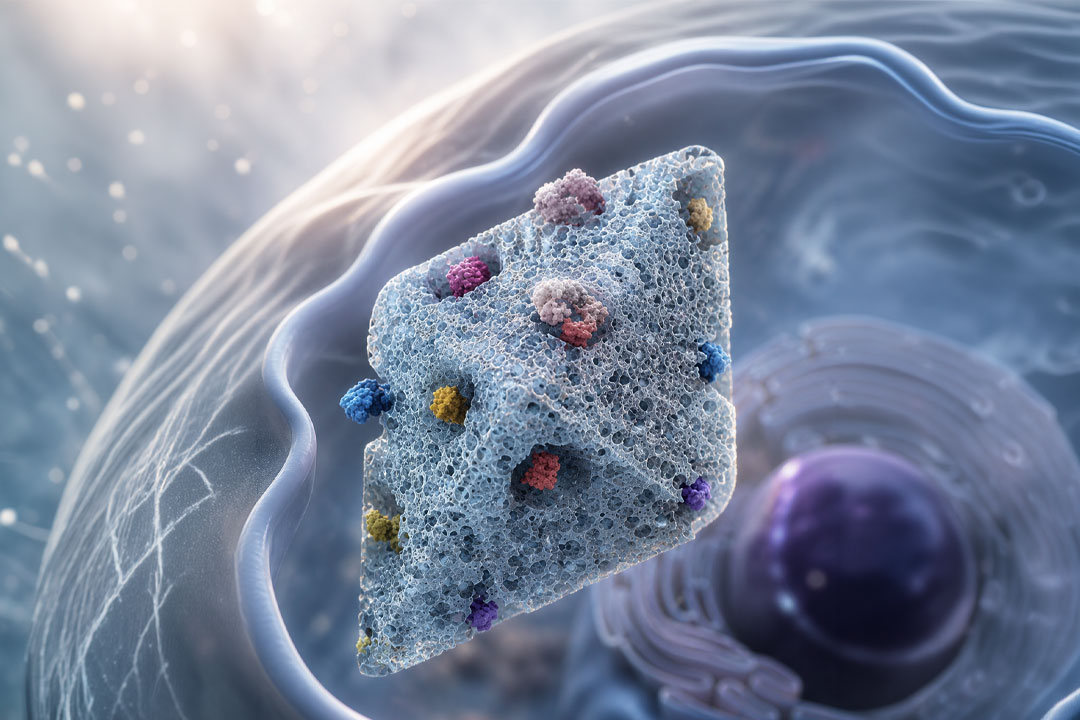
A six-protein team successfully operating inside living cells as a single integrated system, points to a future where medicine could be made directly at the site of disease.
Scientists at King Abdullah University of Science and Technology (KAUST) have engineered small particles that transport a team of six proteins into living cells, where they form a nanoscale factory, working together to produce violacein, a natural bioactive compound being studied for therapeutic applications.
The research offers an early demonstration of how future therapies might one day generate treatment molecules directly inside the body, only where they are needed. This approach could, in time, help treatments act more precisely at the site of disease, while reducing unwanted effects on healthy parts of the body.
Published in Advanced Materials, the study combines nanotechnology, materials science, and bioengineering to address a long-standing challenge in medicine: how to deliver not just a single therapeutic protein, but several working proteins together so they can carry out coordinated biological tasks inside cells.
The KAUST team packaged six proteins inside tiny sponge-like particles known as metal-organic frameworks (MOFs), creating what the researchers describe as synthetic organelles — small, engineered structures that mimic key functions inside living cells. Once delivered into mammalian cells, the proteins remained active and worked sequentially to convert a simple amino acid into violacein. This represents the most complex multiprotein system delivered into living cells to date, and the first example of what researchers describe as a “protein pathway transplant.”
“It was a bit of a moonshot”, explains Raik Grünberg, senior research scientist at KAUST and one of the three corresponding authors of the study. “Protein delivery into the cell is difficult enough for individual proteins, so researchers usually do not even try with more than one or two. What we show here is that we can take a whole integrated protein system, like this complete bacterial biosynthesis pathway, and bring it into human cells as one functional unit. I think this opens a whole new field of interventions.”
“This was a turning point for us,” said Niveen Khashab, professor of Chemical Science at KAUST. “When we used conventional MOF materials, most proteins lost their activity. We realized we needed a different type of material — one that could protect the proteins while still allowing them to function together. By engineering a more porous, sponge-like framework, we were able to create an environment where the system could finally work as intended.”
The system is built on a controllable scaffold, allowing scientists to fine-tune how the proteins behave and interact once inside the cell. By adjusting the composition of the system, researchers can control how the proteins work together, pointing toward more adaptable and programmable therapeutic approaches.
“What makes this work particularly important is that it brings together advances in both materials science and biology to solve a problem that neither field could address alone,” said Stefan T. Arold, professor of Bioscience at KAUST and corresponding author of the paper “By combining expertise across disciplines, we were able to design a system that allows multiple proteins to function together inside living cells. This opens up new possibilities for how therapies might be developed in the future, moving toward more complex and responsive biological systems.”
While the findings are at an early stage, and further validation will be required before clinical application, the work provides a proof of concept for therapies that could one day manufacture beneficial compounds at the site of disease, potentially improving targeting and reducing unwanted side effects elsewhere in the body.
The research reflects KAUST’s growing role in advancing healthcare science in Saudi Arabia and strengthening the Kingdom’s position as a regional hub for advanced bioengineering. By bringing together expertise in materials science, life science, chemistry, nanotechnology, and bioscience, KAUST enables complex interdisciplinary research that few institutions can support at this scale.
As research continues, scientists in the Biomedical Sciences division at KAUST will next explore how the system performs in animal models as they assess its potential for future therapeutic applications.