

Developing new methods to expand porous materials for cleaner energy applications
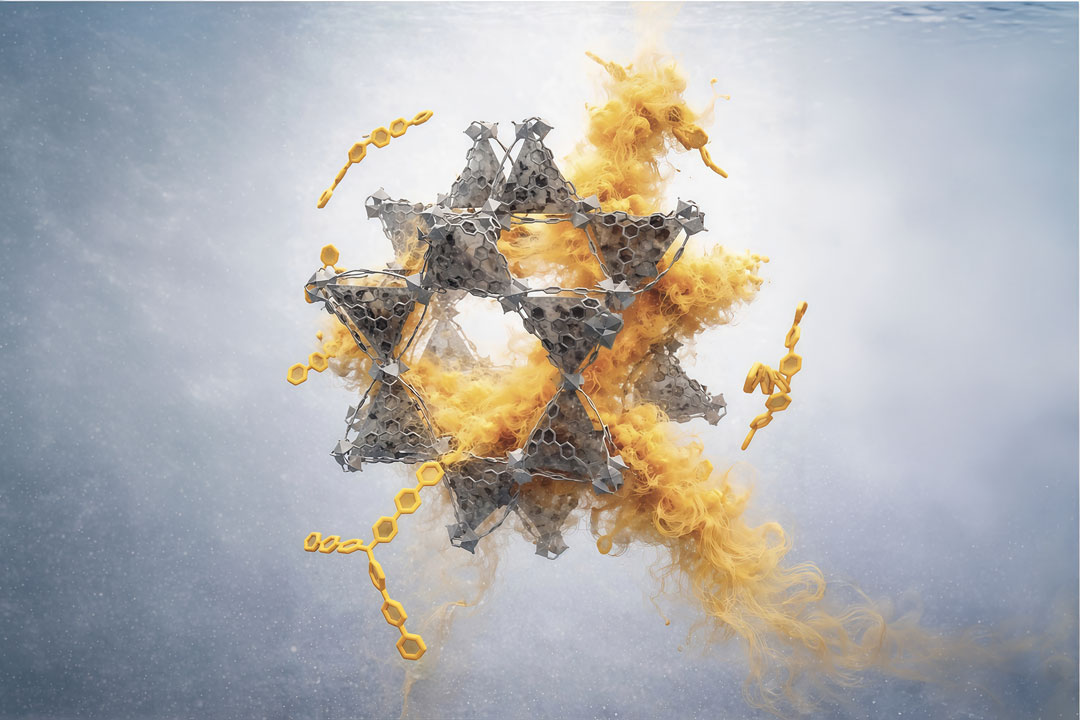
Image credit: Alexandr Sapianik and Marina Barsukova
From foundational discoveries to next-generation solutions, researchers at King Abdullah University of Science and Technology (KAUST) are advancing new ways to engineer porous structures for enhanced gas storage, energy-efficient gas separations, and a range of industrial applications relevant to Saudi Arabia and the world.
Unlike previous approaches, KAUST’s latest method enables the controlled and predictable removal of temporary structural components, creating larger and more uniform pores while significantly increasing pore system capacity. This could lead to more efficient materials for gas storage and processing.
“Transitioning to cleaner energy systems is a global challenge with major economic implications across the Middle East and beyond,” said Professor Mohamed Eddaoudi, who led the research. “The fact that our treatment enabled the creation of a material with one of the highest gravimetric methane storage capacities reported to date is a key milestone, and one that will be of interest not only to academics but also to industry and government agencies.”
Published in Nature Chemistry, the new research highlights a novel way to make highly porous, sponge-like materials used for gas storage, chemical separations, and catalysis more open and efficient after they are already built.
Working under Eddaoudi, Ibn Alhaytham Distinguished Professor of Chemistry, the research team developed two methods to tailor the performance of these metal-organic frameworks (MOFs) while overcoming challenges associated with removing temporary components used during assembly.
Once removed, the materials gained significantly larger pores and much higher storage capacity. In some cases, the pore volume ranked among the highest ever reported for chromium-based MOFs.
“The concept is similar to civil engineering, where temporary supports are removed once an arch or bridge is self-supporting,” said Dr. Vincent Guillerm, senior research scientist and co-corresponding author of the paper.
Researchers from KAUST’s Functional Materials Design, Discovery and Development Research Group and the Advanced Membranes and Porous Materials Platform within the Physical Science and Engineering Division developed the method.
“Our approach eliminates structural elements that assist assembly but do not contribute to the intrinsic three-dimensional nature of the framework, creating additional porosity and reaching record-high pore volumes, as well as one of the best gravimetric capacities for methane storage,” Guillerm added.
Larger and more accessible pores allow materials to store and move gases such as methane, carbon dioxide, and hydrogen more efficiently, improving performance in industrial and energy-related applications.
Eddaoudi noted that the importance of, and global interest in, porous materials research in addressing various enduring challenges facing society was recognized by the 2025 Nobel Prize in Chemistry, which included recognition connected to pioneering work in the field by Saudi citizen Omar M. Yaghi.
KAUST researchers hope their work will support the future design of more efficient materials for energy, environmental, and industrial applications, contributing to the Kingdom’s long-term sustainability goals.