As our society and transportation systems become increasingly electrified, scientists worldwide are seeking more efficient and higher capacity storage systems. Researchers at KAUST have made an important contribution by modifying lithium-sulfur (Li-S) batteries to suppress a problem known as polysulfide shuttling.
“The bottleneck in the utilization of renewable energy, especially in transportation, is the need for high-density batteries,” says Eman Alhajji, Ph.D. student and first author of the research paper.

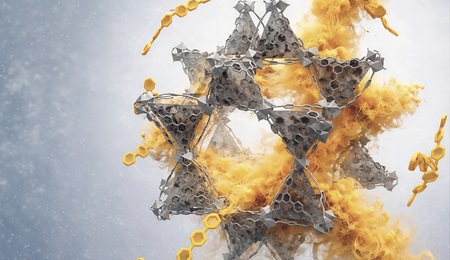
The battery designed by Eman Alhajji (left) and Husam Alshareef (right) is suitable for large-scale commercial application.
© 2021 KAUST; Anastasia Serin
Li-S batteries have several potential advantages over the most commonly used types of batteries. They have a higher theoretical energy storage capacity and sulfur is a nontoxic element readily available in nature. Sulfur is also a waste product of the petrochemical industry, so it could be obtained relatively cheaply while increasing the sustainability of another industry.
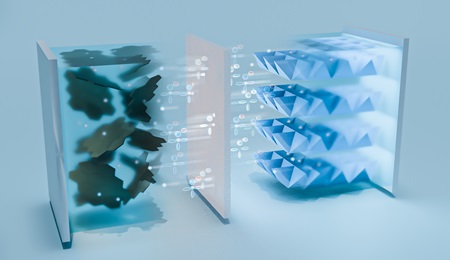
Polysulfide shuttling involves the movement of sulfur-containing intermediates between the cathode and anode during the battery’s chemical processes. This seriously degrades the capacity and recharging ability of the Li-S battery technologies that have been explored to date.

Sulfur-containing batteries suffer from polysulfide shuttling, which degrades the capacity and recharging ability of Li-S batteries.
© 2021 KAUST; Anastasia Serin
The KAUST team’s solution is based on a layer of graphene. They make this by subjecting a polyimide polymer to laser energy in a process called laser scribing, creating a suitably structured porous material. A key feature is that the material is hierarchically porous in three dimensions, meaning it has an array of pores of different sizes. Nano-sized carbon particles are then added and taken up by the pores to form the final product.
Alhajji and her colleagues found that placing a thin layer of this material between the cathode and anode of an Li-S battery significantly suppresses the polysulfide shuttling.
“Making this freestanding interlayer just a few micrometers thick was a challenge,” says Alhajji, adding, “It was fun to roll it like playdough, but then I had to handle it in a very gentle manner, especially during battery assembly.”

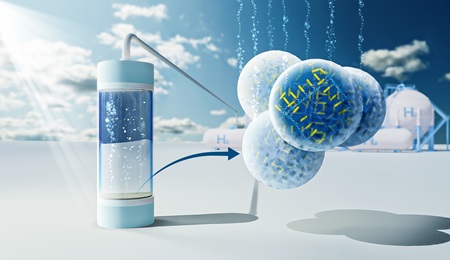
Li-S batteries have several potential advantages over the most commonly used types of battery, such as a higher theoretical energy storage capacity.
© 2021 KAUST; Anastasia Serin
Until now, most options proposed to solve the polysulfide shuttling problem have suffered from limitations that make them unsuitable for large-scale commercial application. In contrast, the laser-scribed graphene developed at KAUST is produced by a method that the researchers describe as “scalable and straightforward.”
Alhajji won a 2021 Materials Research Society Best Poster Award based on her idea for suppressing the shuttling. “This is a really challenging competition,” says Alhajji’s supervisor Husam Alshareef, adding, “Only a handful of students from the Materials Science & Engineering program at KAUST have won this award.”
References
- Alhajji, E., Wang, W., Zhang, W & Alshareef, H.N. A hierarchical three-dimensional porous laser-scribed graphene film for suppressing polysulfide shuttling in lithium−sulfur batteries. ACS Applied Materials & Interfaces 12, 18833-18839 (2021).| article