

KAUST study shows recovering reef fish stocks could boost sustainable food supply by nearly 50%
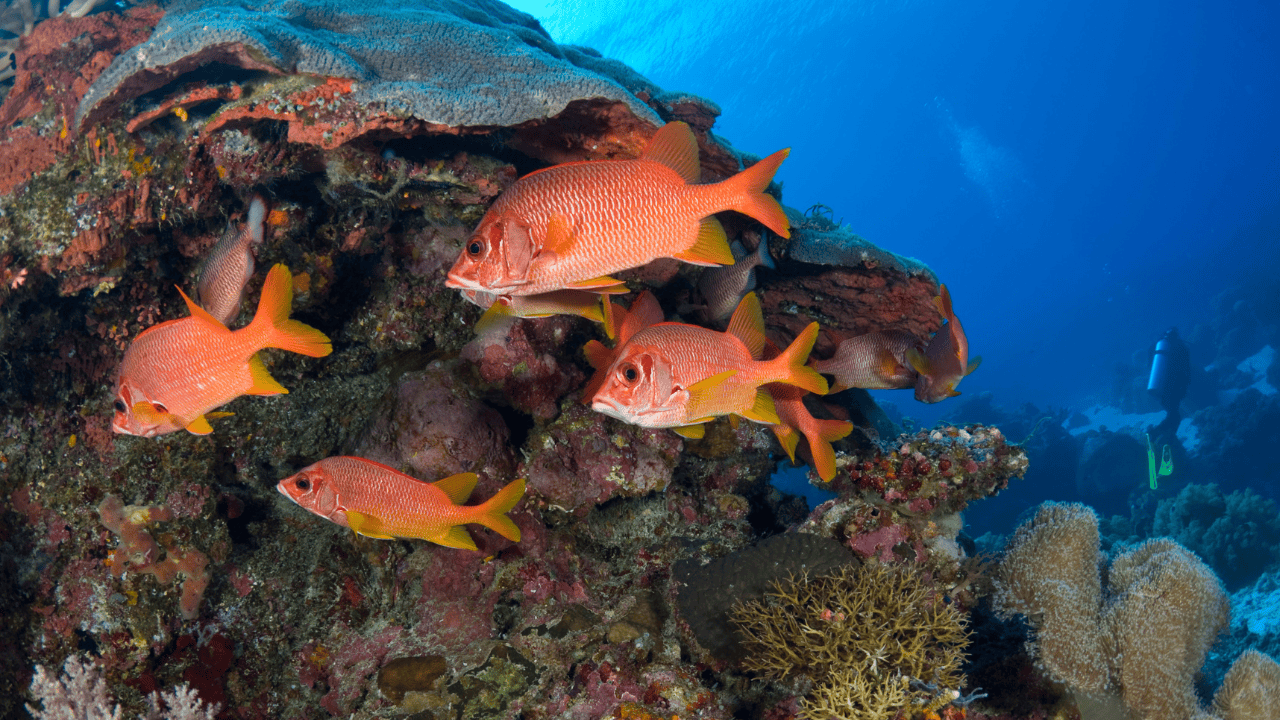
A new study led by King Abdullah University of Science and Technology (KAUST) Assistant Professor Jessica Zamborain-Mason shows that rebuilding depleted coral reef fish populations could significantly increase sustainable food supplies for millions of people worldwide. Published in Proceedings of the National Academy of Sciences (PNAS), the work provides the first global quantification of how much food is currently being lost due to degraded reef fish stocks and how much can be regained if reefs are restored to sustainable levels.
Drawing on one of the largest coral reef datasets assembled to date, the study analyzes more than 1,200 reef sites across 23 tropical jurisdictions. The findings come at a critical moment: reef ecosystems are experiencing widespread climate-driven impacts, and if reef fisheries are overexploited, ecosystem resilience and tropical food systems are at risk.
“Our study provides clear, quantitative evidence of how much food tropical coastal communities are losing — and could regain — through sustainably managed reef fisheries,” said Zamborain-Mason. “These insights give governments the scientific foundation needed to strengthen food security and ecosystem resilience through effective fisheries management.”
Zamborain-Mason and colleagues from institutes in nine countries examined reef sites where fish biomass has fallen below levels required to support maximum sustainable production. Using ecological field data, environmental variables, and a fisheries modeling framework, the team estimated both the current sustainable yield of reefs and how much additional yield could be realized if the reef fish stocks were allowed to recover.
This approach allowed the researchers to quantify, for the first time on a global scale, the gap between what reef ecosystems are producing now and what they could provide if rebuilt.
Based on median estimates, their analysis showed that reefs could increase sustainable yields by nearly 50% if fish populations were restored to sustainable biomass levels.
For countries such as Indonesia, doing so could result in as many as 162 million additional sustainable servings of reef fish per year, which would translate into 1.4 million additional people being fed annually. On the local scale, many sites across the globe could produce thousands of additional fish servings per square kilometer, helping meet the nutritional needs of coastal communities that rely heavily on reef-based aquatic foods.
The potential gains are greatest in countries facing high levels of malnutrition. Jurisdictions such as Madagascar, Mozambique, Tanzania, Kenya, Indonesia and the Philippines are currently losing between 2,500 and 32,400 tonnes of sustainable reef fish production annually due to depleted stocks. For some of these regions, recovered reef fisheries could more than double—or even triple—the number of people meeting recommended seafood consumption.
The study also highlights that recovery will require time and strategic management. While recovery timelines will depend on current depletion levels and the strength of management regulations, the researchers calculated that, on average across all the reefs examined, rebuilding reef fish populations could take from 6 to nearly 50 years, depending on the level of fishing.
These timelines underscore the importance of long-term policy commitments, effective fisheries monitoring and management, and context-specific investments in alternative livelihoods to support communities during rebuilding periods.
This research advances KAUST’s broader mission to strengthen national and global food security through world-leading marine science and Red Sea research. While the study focuses on global reef systems, its insights are highly relevant to Saudi Arabia, where sustainable fisheries play a central role in Vision 2030’s environmental stewardship, food self-sufficiency, health and blue-economy development.
Through its leadership in Red Sea and coral reef science, KAUST is generating the evidence needed to inform sustainable fisheries management and ecosystem-based decision-making at global and national scales. These findings are directly applicable to the Kingdom’s reef resources and resonate strongly with Saudi Arabia’s efforts to safeguard the Red Sea as a strategic national asset.
Sustainable fisheries are central to ecosystem protection and food security along the Kingdom’s coastline. By quantifying the food-production potential of restored reefs, the study reinforces the value of evidence-based fisheries management,
This research reinforces the University’s role in translating fundamental science into insights that support Saudi Arabia’s long-term goals for environmental stewardship, sustainable food systems, and the responsible development of its coastal and marine resources under Vision 2030.