

New dean Professor Husam Alshareef focuses on impact, talent, and national priorities
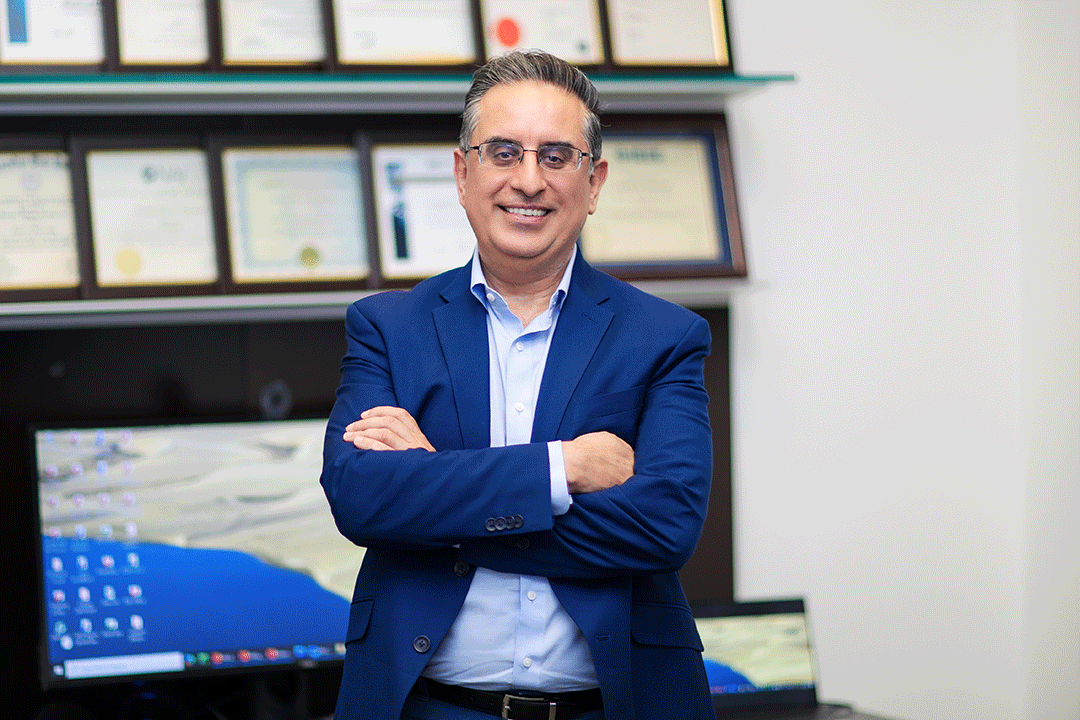
Professor Husam Alshareef, a founding KAUST faculty member, has been appointed dean of the Physical Science and Engineering Division.
Professor Husam Alshareef joined the founding cohort of King Abdullah University of Science and Technology (KAUST) in 2009, drawn by the collective ambition of its earliest academic community to establish a “House of Wisdom in the Arab World.” It is a pursuit he still sees reflected in KAUST to this day.
“The vision attracted me here, and to be honest, it still does,” he said. “Policies and strategies may change, but at the end of the day it’s all about the same thing: solving challenges facing the Kingdom and the world by bringing bright people together and giving them the resources and infrastructure they need to succeed.”
The Ibn Alhaytham Distinguished Professor of Materials Science and Engineering will now help shape that mission more directly than ever as the new dean of the Physical Science and Engineering Division. “My vision is to lead an internationally recognized division known for groundbreaking science and impactful research, helping Saudi Arabia achieve its economic diversification and environmental goals, including those outlined in Saudi Vision 2030.”
Being trusted by KAUST leadership and President Sir Edward Byrne AC to take on the role as dean of the division is something he sees as both an honor and a responsibility. “I must provide leadership by example and remain engaged to rally the people around the mission.”
Alshareef’s academic path began with his family’s traditional ceramics business, which led him to study ceramics engineering at Alfred University in the United States. He later shifted his focus to materials science and engineering because of its broader scope, pursuing his master’s and Ph.D. degrees at North Carolina State University. He later received a postdoctoral fellowship at Sandia National Laboratories in the U.S.
His career spans Sandia, Micron Technology, Texas Instruments, and the University of Texas at Dallas, and includes nearly 650 journal publications, 100 conference papers, 80 patents, and multiple prestigious fellowships. A highly cited pioneer in nanoscale materials research for energy and electronics, he continues to advance the field with a growing emphasis on translational impact.
Leadership roles at KAUST
Since joining KAUST in 2009, Alshareef has held two key leadership roles that he sees as preparation for the deanship. In 2024, he led the successful establishment of the Center of Excellence for Renewable Energy and Storage Technologies (CREST), together with 18 researchers he considers among the world’s most talented in renewable energy.
“In my opinion, this is one of the strongest teams I have had the privilege to work with,” Alshareef said. “In its short existence, CREST has already gained international recognition as a leading hub of renewable energy and storage research.”
Alshareef will continue to direct the center’s focus on translational projects related to sustainable technologies until June 2026.
His role as chair of the Materials Science and Engineering Program in the early days of KAUST also strengthened his academic credentials as a leader. He played a key role in developing the program, recruiting many of its current faculty members, and establishing its bylaws and curriculum. Today, the program is highly ranked by several international ranking organizations.
As he takes on leadership of the Physical Science and Engineering Division, Alshareef added, the role will require an approach inclusive of the entire academic community.
“It’s a transition from thinking locally just about a group, program, or center to thinking globally about the many people in the division — a role where leading by example and empowering people and helping them realize their full potential is key to success.”
New plans for the division
As dean, Alshareef said he intends to maintain a consensus-driven leadership approach, collecting input before making decisions. “Active engagement and strong advocacy for our faculty, researchers, and students are critical aspects of my leadership style.”
Streamlining and establishing well-documented, clear processes for all aspects of division operations are among the priorities Alshareef will emphasize, he added. “We would like to introduce clarity and consistency in everything we do in the division.”
To strengthen KAUST’s mission-focused research, Alshareef is establishing a new unit in the dean’s office focused on research and innovation to help connect the division with KAUST’s internal entities and external Saudi institutions, ministries, and industrial partners. The role will help identify opportunities for faculty, shape collaborations, and expand the University’s capacity to deliver tangible value.
Alshareef said the Physical Science and Engineering Division’s priorities will continue to uphold KAUST’s goals, aligning with the Kingdom’s objectives of economic diversification, localization, and workforce development. To support these goals, he will enhance the division’s translational partnerships, align more closely with stakeholder needs, and expand opportunities for faculty engagement.
Further, he noted, the division will modernize its curriculum, integrating artificial intelligence skills and introducing soft skills classes that build communication, teamwork, and problem-solving abilities for students and researchers. “We must understand the Kingdom’s needs thoroughly and align our educational and translational activities to serve its best interests.”
Recruiting world-class faculty will remain a priority, he added, noting that talented faculty serve as “a magnet” for attracting strong students, researchers, and Kingdom partners needed to meet the demands of critical industries and the broader economy.
“Our division will focus on energy research, which will be the primary mission of the division. We will align our research and translational activities with the country’s priorities, particularly those of the Ministry of Energy. This includes the traditional energy sector, oil and gas, which remains central to Saudi Arabia’s economy, as well as renewable energy and storage, critical minerals, energy efficiency, and low-carbon fuels.”
Looking ahead, Alshareef said he hopes his tenure as dean will be remembered for enhancing KAUST with exceptional faculty who attract talent and investment, as well as for enabling researchers to generate both academic impact and successful startups that advance national priorities.
A deep commitment to KAUST’s mission
Alshareef said his appointment draws on strengths that position the division to contribute meaningfully to the University’s mission, including scientific and industrial experience, a deep understanding of the division’s research landscape, the ability to bring people together, a strong in-country network, and a solid record of collaboration.
KAUST remains a place where talented people from around the world work together to address major challenges facing Saudi Arabia and beyond, he noted. For Alshareef, the University’s resources and environment have helped shape a rewarding academic career. As dean, in the spirit of KAUST, he hopes to continue empowering others.
“I hope to be able to give back by continuing to enhance KAUST’s academic reputation, providing solutions to our industrial partners, preparing the next generation of engineers and researchers, and making practical impacts in the Kingdom,” he added.