

KAUST showcases its smart health technologies at global forum
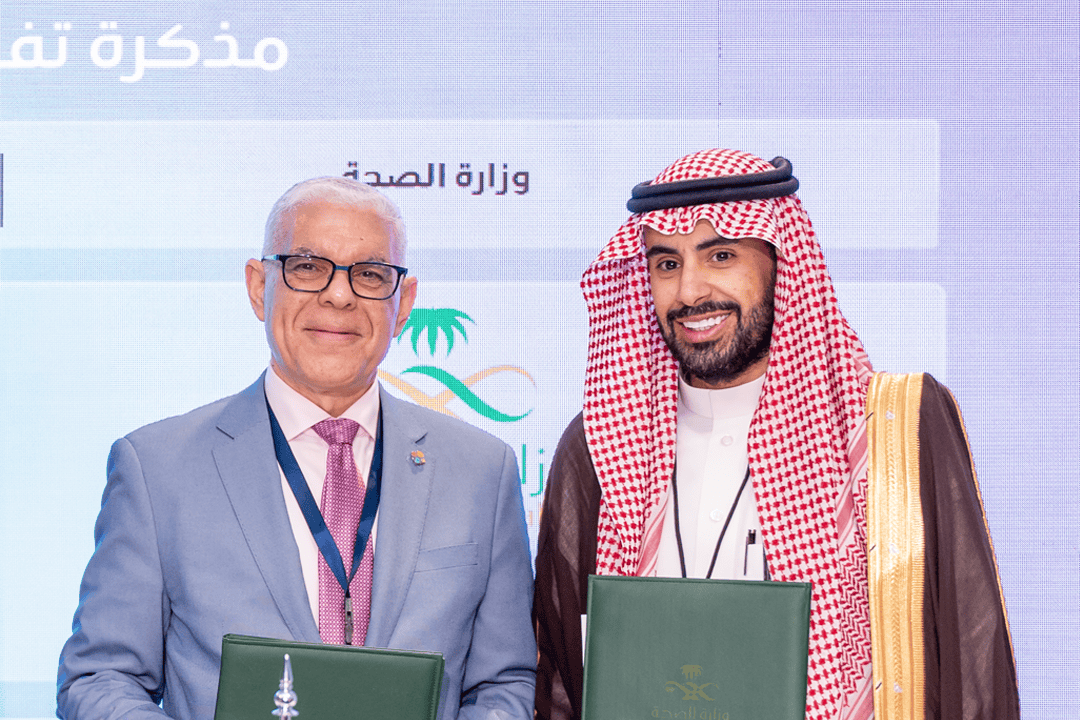
Professor Imed Gallouzi, chair of the Center of Excellence for Smart Health, and His Excellency Dr. Khalid bin Adnan Al-Buraikan, deputy minister of health for investment, signing an MoU at the exhibition.
King Abdullah University of Science and Technology (KAUST) is accelerating a new era of smart health innovation – transforming scientific discovery into practical technologies that strengthen healthcare systems in Saudi Arabia and around the world. At the heart of this effort is the KAUST Center of Excellence for Smart Health (KCSH), led by Professor Imed Gallouzi. KCSH is tackling critical medical challenges through AI, computational biology, advanced sensors, and next-generation diagnostics.
This mission recently took the spotlight at the Global Health Exhibition in Riyadh, where KAUST showcased breakthrough technologies and signed agreements with Saudi partners for research collaborations. As one of the world’s largest gatherings of healthcare innovators, the exhibition provided a prominent stage for KAUST to present its research portfolio, featuring technologies that are being developed with the aim of being adopted and implemented in patient care in the future.
Pioneering therapies in autism
With one in 30 children in Saudi Arabia diagnosed with autism spectrum disorder, advancing early diagnosis and effective management has become an urgent national priority. In response, KCSH researchers are developing scalable, data-driven tools to improve early detection and long-term support.
Professors Ahmed Eltawil and Xin Gao are pioneering a suite of technologies to transform autism diagnosis and care from multi-sensor wearables that capture everyday behavioral patterns, to a multilingual AI assistant that builds communication and social skills through interactive stories. Their work also includes an assistive companion robot designed for real-world learning and play, and an adaptive web platform that uses computer vision, emotion recognition, and language analysis to personalize learning and track developmental progress.
Smartphone-based diagnostics
KAUST researchers are also advancing healthcare through tools like SkinGPT-4, which was developed by Gao. This AI system analyzes dermatological images and suggests possible conditions, improving diagnostic access, especially in remote communities. An innovative technology developed by Professors Stefan Arold and Magnus Rueping using engineered nanobodies to detect dengue and Zika viruses was also on display. This diagnostic platform enables rapid, reliable, and highly sensitive detection using minimally invasive samples.
Wearable technologies for real-time health monitoring
In smart sensing and wearable health, Professor Atif Shamim has developed a wirelessly connected smart bandage that monitors wound pH, bleeding, and pressure, all critical parameters in chronic wound care. Printed using low-cost conductive inks on flexible substrates, the device aims to provide real-time alerts, enabling continuous monitoring for patients with diabetic ulcers and other long-healing injuries without removing the bandage or disrupting recovery.
Global expertise on the world stage
Along with KAUST technologies, the exhibition featured several KAUST speakers including Gallouzi; Professor Peter Goadsby, one of the world’s most renowned neurologists and a recent addition to KAUST; Professor Bruno Reversade, a leading human geneticist and developmental biologist; and Dr. Riddhi Shukla, Head of Technology Deployment. Across their respective sessions, KAUST demonstrated its broad leadership in genomics, medical AI, and digital health – reinforcing the University's role as a rising global contributor to next-generation healthcare solutions.
Building a national smart health ecosystem
Collaboration is key to KCSH's mission. The University works closely with government, healthcare institutions, and industry to ensure innovations can be deployed quickly and efficiently. Adding to these collaborations, KAUST signed partnership agreements at the exhibition with the Ministry of Health, International Medical Center and Fakeeh Care Group to accelerate innovation and investment in AI-driven healthcare and precision medicine.
KCSH Chair Imed Gallouzi: “At the Global Health Exhibition, KCSH showcased achievements in smart health and signed new agreements with key stakeholders in Saudi Arabia. Together, these efforts highlighted our research-driven mission to integrate biology, engineering, and AI in partnership with national stakeholders to advance innovations that deliver real-world health impact across the Kingdom and beyond.”