

KAUST researchers pioneer portable carbon capture to cut industrial emissions
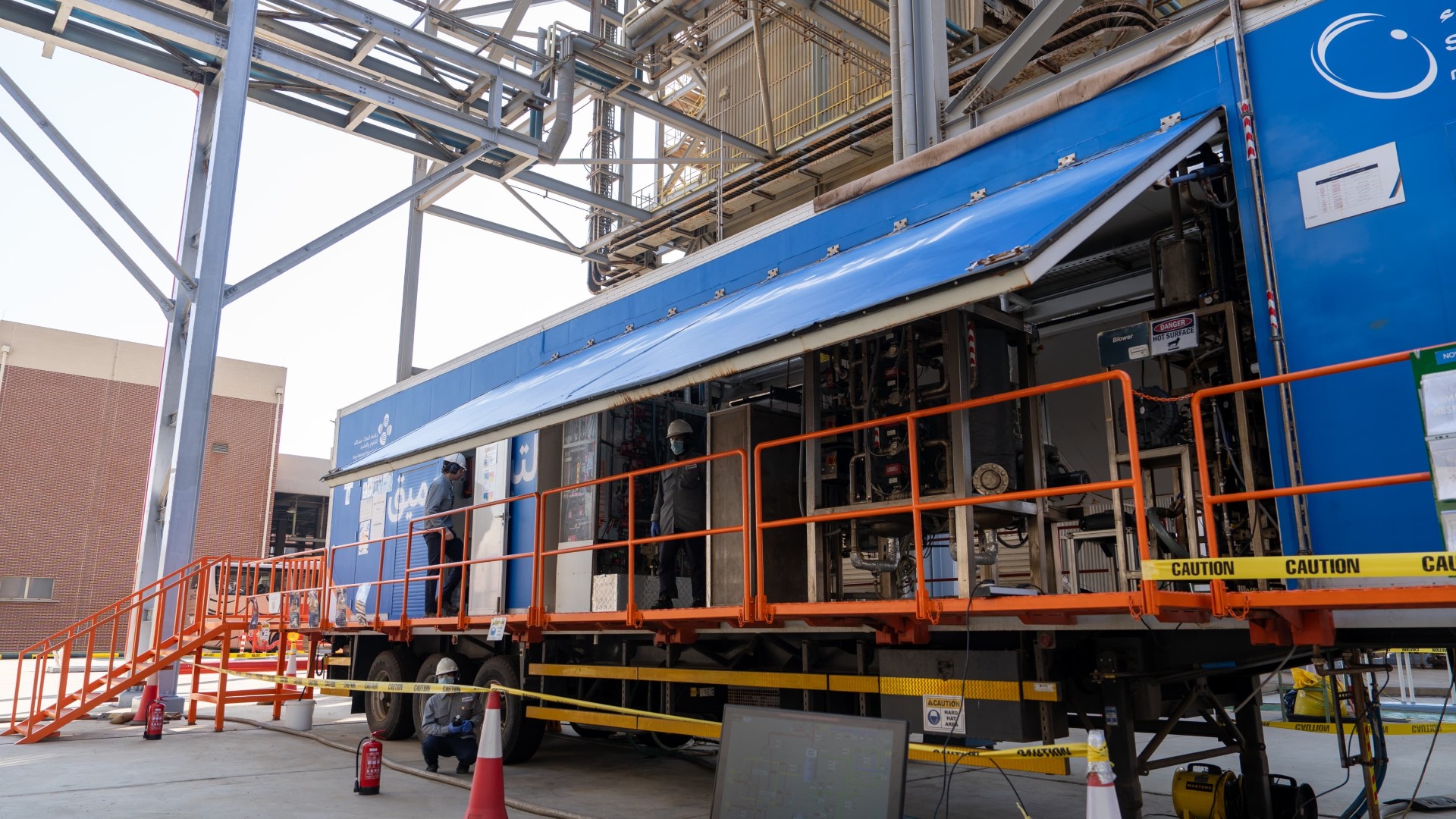
KAUST’s cryogenic carbon capture (CCC) pilot unit operates at the Saudi Electricity Company power plant in Rabigh as part of ongoing field validation efforts.
Putting the freeze on climate change, King Abdullah University of Science and Technology (KAUST) continues to lay the groundwork for industrial emissions reductions through cryogenic carbon capture (CCC) technology, while also working to apply this innovation at sea and generating strong international interest along the voyage.
“We have developed a smart Lego-blocks concept of portable, containerized carbon-capture cabins that can be stacked on a ship to capture carbon dioxide (CO2) along with sulfur dioxide (SO2) for two to four weeks of the ship voyage, with post-processing purification done onshore,” said Dr. Sai Shrinivas Sreedharan, technology manager for KAUST’s CCC initiative.
“This has a dual benefit of reducing the footprint of the CO2 capture system and eliminating scrubbers for ships running on heavy fuel oil — the most widely used marine fuel,” he added, referring to a system of modular units fitting together, with the captured CO2 purified, compressed, and prepared for storage or reuse. A hub-and-spoke model centralizes processing while using distributed units to collect emissions.
“It garnered strong interest when we visited the Powering the Intelligent Age Summit 2025 in Kuala Lumpur, co-organized by Malaysia Centre4IR and the World Economic Forum.”
The University has been active on the CCC front since 2020. In November 2024, KAUST and Saudi Electricity Company (SEC) launched a demonstration exercise, Sreedharan noted, showcasing the world-first cryogenic technology that captures multiple pollutants and greenhouse gases.
“KAUST, with its facilities and talent, is well placed to engage in technology development, then to bring the technology into the real world and have impact. One of the approaches is for the University to collaborate with strategic third-party entities to support commercialization of the technology.”
Technology readiness rising
As a maturity scale, technology readiness levels (TRLs) describe how far a technology has progressed, from level 1 as an early concept to level 10 as ready for real-world use. Since launching the CCC pilot study and the initial TRL 6 validation at SEC’s Rabigh power plant, Sreedharan noted, KAUST has built on operational experience to further mature the technology into a fully in-house solution, enabling the development of new proprietary intellectual property.
The existing demonstration rig now serves as an IP development and validation platform, with revalidation at TRL 6 planned for the near term. The technology is now positioned for commercial-scale deployment nationally. Building on this validation, the next milestone is demonstrating commercial readiness, when KAUST delivers a first-of-a-kind 30-tonne-per-day CO2 capture system at SEC’s power plant.
“We have engaged partners who are helping us chart a plan to ensure we reach the right cost targets,” Sreedharan said. “That is why we have initiated early engagement with Tier 1 in-Kingdom partners to support the technology selection study and ensure cost-competitive outcomes.”
Opportunities at sea
The International Maritime Organization (IMO), an agency of the United Nations, is developing a Net-Zero Framework for the maritime industry.
One member of the CCC team — Senior Research Scientist Dr. Deoras Prabhudharwadkar, who serves on a scientific advisory group to the IMO — has been advising the IMO on accurate accounting of greenhouse-gas life-cycle emissions with and without onboard carbon-capture systems and for various new fuel pathways.
This reflects KAUST’s deeper expertise in the subject matter. Sreedharan said a prototype specific to marine applications is in fabrication, and testing is expected to begin soon.
“We expect to test the marine-specific prototype in the near future. The subsequent go-to-market phase will focus on engaging third-party stakeholders and investors interested in marine carbon and multi-pollutant capture through relevant IMO-led forums, Saudi Green Initiative events, and industry platforms.”
He added: “The system for marine application is designed as a plug-and-play solution, where the exhaust is connected directly to a compact multipollutant capture module and all condensable pollutants are captured and stored in solid form. This significantly minimizes onboard footprint, which is critical in marine applications where space directly impacts revenue, while downstream post-processing can be carried out onshore.”
Mission-driven approach
By developing cryogenic carbon-capture intellectual property in-house, KAUST is highlighting its mission-driven approach, unlocking new startup opportunities, attracting external funding through the National Transformation Institute (NTI), and strengthening the University’s and the Kingdom’s position in a field essential to environmental sustainability in line with Saudi Vision 2030.
“We decided to develop our own system, which we will validate imminently through partnering with neighboring Saudi power plants once again,” Sreedharan said, adding that CCC proponents are also supporting a circular carbon economy, entering projects with pathways to CO2 reuse.
“If we can enable the capture and recycling of CO2 and other pollutants from existing marine, power, and industrial exhaust in a cost-effective manner with minimal impact on existing infrastructure, we can bridge the transition to cleaner fuels while substantially reducing the emissions footprint of current operations.”
Award-worthy technology
KAUST’s CCC technology cools flue gases — the exhaust released from industrial combustion — to extremely low temperatures, solidifying CO2 and other pollutants for efficient separation. KAUST built and tested the trailer-scale system before deploying it for six months at SEC’s Rabigh Power Plant. The project aligns with Saudi Arabia’s carbon-neutrality ambitions and the national requirement for new power plants to include carbon-capture capability.
Reinforcing KAUST’s advancement of scalable carbon-capture solutions for the energy transition, Sreedharan noted that the CCC initiative, in partnership with SEC, earned international recognition with two awards in 2025, including special recognition at the Emirates Energy Award and R&D Project of the Year at the Asian Power Awards in Kuala Lumpur.
“These awards created international visibility,” he said, adding that, because of these recognitions, KAUST has received several domestic requests for CCC facility demonstrations. “Their eagerness to have these demonstrations reinforces our belief that there is a strong appetite for this technology in the real world.”
Powered by partnerships
KAUST, in collaboration with its partners, has developed a compact, trailer-mounted cryogenic multipollutant capture system designed to capture CO2 and other condensable pollutants at an initial scale of approximately a quarter tonne of CO2 per day.
The trailer-mounted rig serves as a scale-up de-risking platform, with KAUST providing the underlying technology and innovation, guided by operational experience and decarbonization priorities from SEC. Successful demonstration is expected to inform SEC’s investment decisions for future scale-up and deployment.
During the Rabigh pilot, the KAUST system has reliably and efficiently captured more than 95 percent of CO2 in continuous, multi-hour industrial operations. KAUST studies show CCC performs favorably compared with other approaches, particularly in applications with low CO2 concentrations and in exhaust streams containing SO2 and other co-pollutants that can challenge conventional systems.
The process produces high-purity liquid CO2, enabling pathways for use in petrochemicals, underground injection, or supercritical CO2 power cycles. Researchers at the University are maximizing CO2 purity, along with the separation of SO2 and nitrogen oxides from flue gases.
Since the pilot project began, Sreedharan said, KAUST and its project partners have refined the technology through in-house development informed by operational experience, supporting deployment pathways aligned with the Kingdom’s 2060 net-zero goals and enabling meaningful emissions reductions well ahead of that timeframe.