

KAUST researchers honored in 2026 L’Oréal-UNESCO For Women in Science program
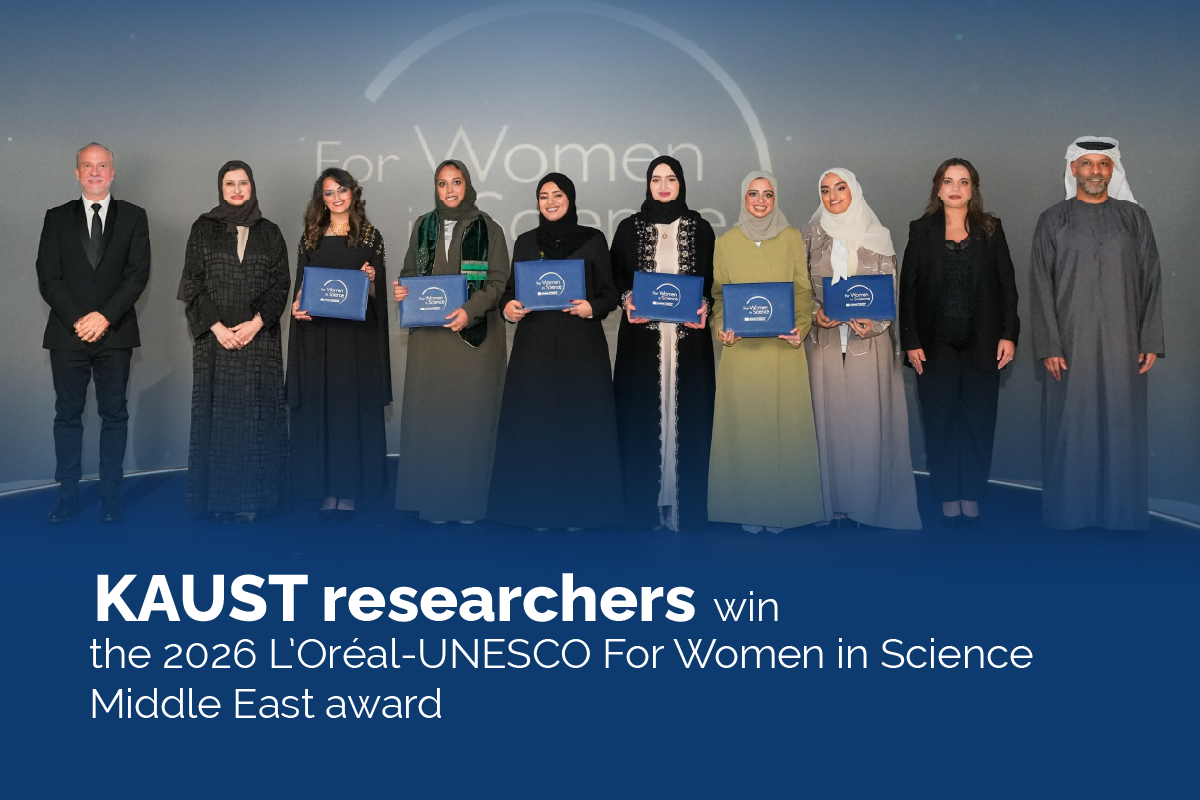
Two researchers affiliated with King Abdullah University of Science and Technology (KAUST) have been named among the 2026 L’Oréal-UNESCO For Women in Science Middle East Regional Young Talents honorees, marking the fourth consecutive year that KAUST-affiliated scientists have received recognition through the program.
Ph.D. candidate Alaa Almushaikeh, an applied physics researcher at KAUST specializing in advanced materials for radiation detection and X-ray imaging, was recognized for her work on high-performance scintillators.
Dr. Aljawharah Alrubayyi, a recipient of the Ibn Rushd Postdoctoral Fellowship and a research fellow in the Peppa Lab at University College London and the Gaiha Lab at the Ragon Institute of Mass General Brigham, MIT and Harvard, was honored for her research in biomedical sciences.
The L’Oréal-UNESCO program elevates early-career women researchers whose work addresses global challenges across science, technology, engineering, and mathematics (STEM).
For Almushaikeh, who studies applied physics under Professor Omar F. Mohammed, receiving the award supports the next phase of her research and provides a valuable platform to communicate her work. She is developing more affordable, high-performance light-emitting materials called scintillators, which convert X-rays into lower-energy light detectable by cameras or imaging detectors, ultimately aiming to improve the quality and efficiency of X-ray imaging.
“I hope this award will allow me to build on the advanced performance we have already demonstrated with these materials and take the research closer to real-world applications,” Almushaikeh said.
“The next step is to evaluate our scintillators under more demanding radiation and imaging conditions and explore how they can overcome some of the limitations of conventional scintillators, ultimately enabling more efficient and versatile imaging for applications such as medical diagnostics and security screening.”
Almushaikeh said the recognition represents an important milestone that could help her expand the scope of her research, establish new collaborations, and continue building an independent research direction in advanced radiation imaging. “On a personal level, this recognition is especially meaningful because I have seen accomplished researchers at KAUST receive this award before me. To now join them as an awardee is a real honor.”
She added: “I am also proud to represent Saudi Arabia through a recognition that celebrates both scientific excellence and the growing contribution of women to research in our region.”
Alrubayyi’s research focuses on immunology and viral infections. For her, the award is a source of personal pride and recognition of those who have supported her, while encouraging her pursuit of research independence in her field.
KAUST support
Alrubayyi credits KAUST’s Ibn Rushd program with supporting her professional development. She highlighted the guidance and encouragement of Professor Osman Bakr, her KAUST mentor Professor Arnab Pain, the Ibn Rushd team, and faculty in the Biomedical Sciences Division as important factors in her development as a researcher.
“The opportunity to gain international research experience while building connections with KAUST has supported my career development,” she said, adding that Ibn Rushd is just one example of KAUST’s investment in women researchers. “For me, supporting women in science means providing the opportunities, visibility, and resources to develop their ideas and grow into leadership roles.”
Almushaikeh credits KAUST’s research facilities, collaborative environment, and the guidance of her supervisor, Mohammed, with helping her develop as a scientist and pursue her own research ideas. “KAUST has given me world-class research training and the freedom to work across materials science, applied physics, radiation detection, and imaging,” Almushaikeh said.
“International collaborations have broadened my scientific perspective, while student leadership roles have strengthened my ability to communicate, connect people, and lead beyond the laboratory. Together, these experiences have shaped me into a more versatile and independent researcher.”
Empowering women
Alrubayyi remains inspired in her field by the potential to better understand the human immune system, improve vaccines and treatments, and strengthen preparedness for future pandemics. She advises young Saudi women interested in science to gain research experience, find mentors who support and challenge them, and confidently pursue opportunities. “Be persistent, be open to learning, and don’t be afraid to ask for support,” Alrubayyi said.
Similarly, Almushaikeh advises aspiring women scientists to pursue their interests with confidence, learn from setbacks, and remain open to new opportunities. She added: “There are more opportunities than ever for Saudi women in STEM, and I hope young women feel encouraged not only to participate in science, but to help shape its future.”
Their recent recognition builds on KAUST’s sustained record of success in the L’Oréal-UNESCO program, which demonstrates the University’s investment in women researchers and its broader contributions to advancing research and innovation in Saudi Arabia and worldwide.