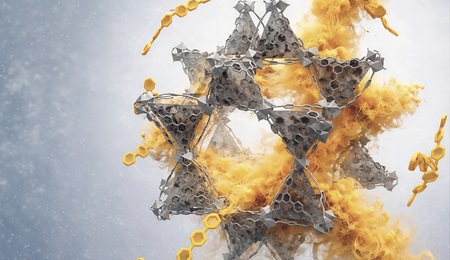
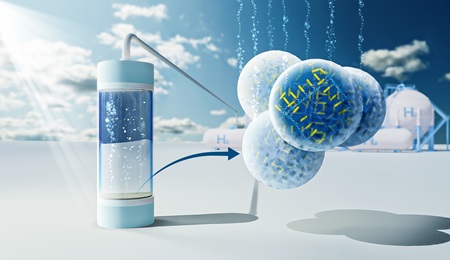
An emerging type of material called a metal-organic framework (MOF) could help improve the delivery of genetic material for treating disease.
MOFs are hybrid materials constructed from metal ions linked by organic molecules. In biomedicine, they have mostly been used as delivery vehicles for small-molecule pharmaceuticals, but now a KAUST-led team has developed a MOF-based system for getting DNA across cell membranes into target cells.
The researchers built their MOFs using a collection of nucleic acid and unnatural amino acid building blocks tethered together by zinc atoms, assembled in a pyramid-like array. They loaded up the resulting materials with single-stranded DNA. The structures protected the genetic cargo from enzymatic degradation and helped ferry the single-stranded DNA into cells, where it ended up inside the nucleus — the cell’s inner sanctum where all gene activity takes place.
A critical challenge in gene therapy remains the safe and effective delivery of genetic materials, and most methods in use today are costly, inefficient, imprecise or potentially toxic. The KAUST-devised delivery system could offer an improved means of regulating gene expression and function in people’s cells as a way of treating cancer, hemophilia and many more genetic disorders.
“These biocompatible frameworks can work as stabilizing platforms for genetic material, especially for future applications in vaccination and personalized medicine,” says lead investigator Niveen M. Khashab from KAUST, who described the materials system in the journal JACS Au, along with her students Othman Alahmed and Walaa Baslyman and with postdoc Santanu Chand.
The researchers detailed how a particular nucleic acid included in their MOFs — a molecule called adenine, one of the four chemical bases in DNA — pairs with its partner nucleic acid on single-stranded DNA to promote loading of genetic cargoes. Computational analyses also demonstrated the importance of electrostatic interactions in the encapsulation of DNA within their platform.
The material that worked best for getting DNA into cell nuclei showed a needle-shaped structure with a size range of about 500–600 nanometers. That’s tinier than even the smallest human cell, but Khashab believes an even more minuscule version might work better. She says, “We are in the stage of preparing smaller particles in the nanoscale region to assure efficient cell internalization for upcoming studies in mice.” If successful, human trials could follow.
References
-
Chand, S., Alahmed, O., Baslyman, W., Dey, A., Qutub, S., Saha R., Hijikata, Y., Alaamery, M. & Khashab, N. DNA-mimicking metal-organic frameworks with accessible adenine faces for complementary base pairing. JACS Au 2, 623–630 (2022).| article