

Positioning energy storage as the backbone of the clean energy transition
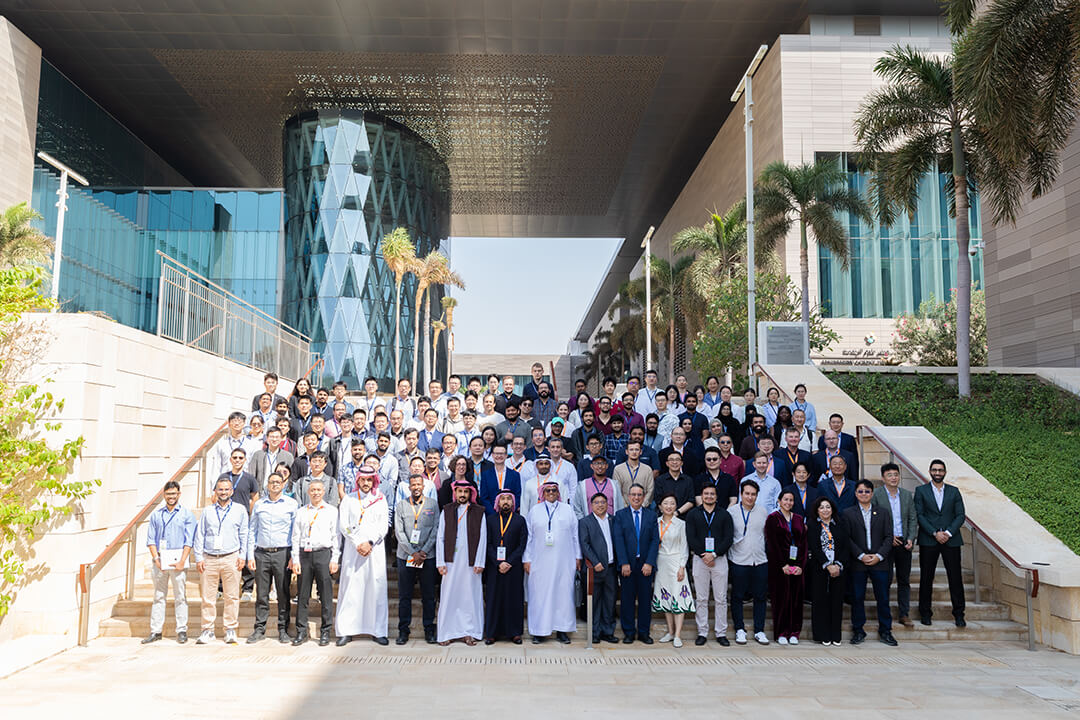
Attendees at the KAUST Research Conference: Frontiers in Energy Storage 2026 gather on campus to discuss next-generation energy storage technologies.
For decades, Saudi Arabia has been a driver of the global economy, leveraging its hydrocarbon resources to power economies around the world.
Now, as the global energy transition accelerates toward renewables, King Abdullah University of Science and Technology (KAUST) is pivoting that legacy, advancing collaborative, in-Kingdom energy-storage technologies essential to delivering reliable, clean baseload energy and addressing the intermittency challenge of solar and wind power.
“We are here to rewrite the rules — at least in part — of what is possible,” KAUST President Sir Edward Byrne AC told the delegates at the KAUST Research Conference: Frontiers in Energy Storage 2026. “The future of energy is being written here, now, in 2026, on the shores of the Red Sea.”
Hosted by the Center of Excellence for Renewable Energy and Storage Technologies (CREST), February 2-4, the conference presented a unified, multi-layered vision of energy storage spanning electrochemical and chemical systems, including advanced batteries and hydrogen, positioning them not as competitors, but as complementary layers for long-duration and industrial resilience.
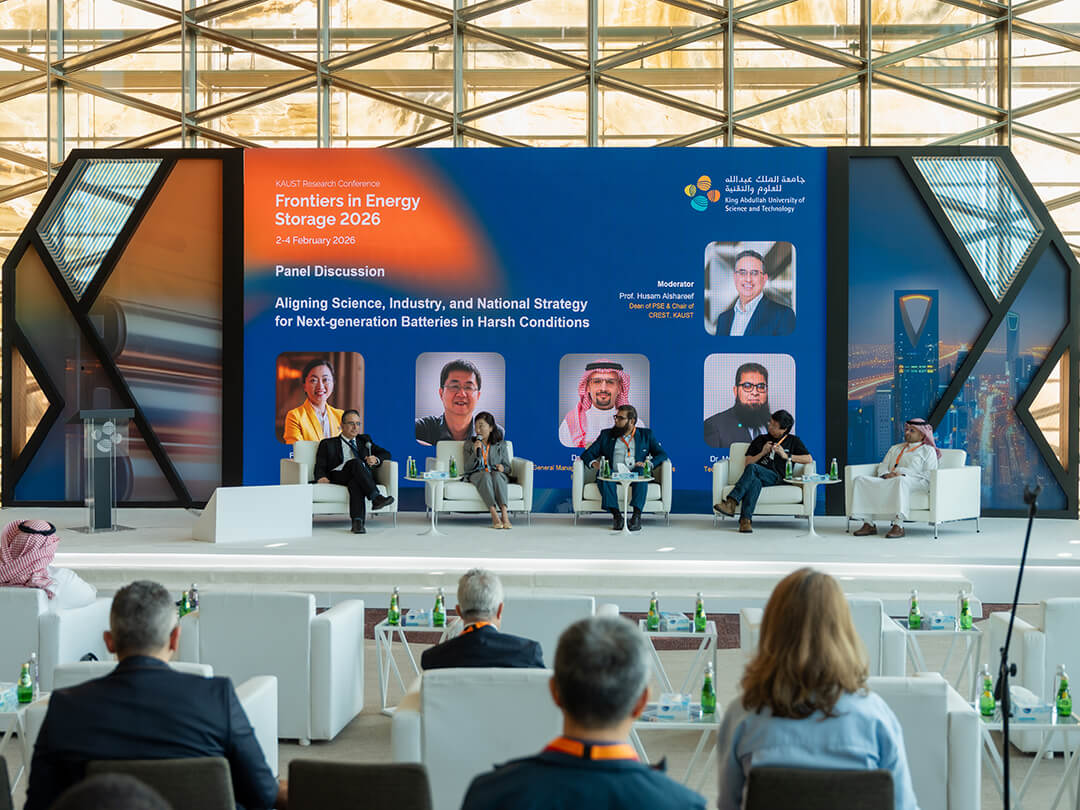
Professor Husam Alshareef, chair of the Center of Excellence for Renewable Energy and Storage Technologies and dean of the Physical Science and Engineering Division at KAUST, moderates a panel discussion on aligning science, industry, and national strategy for next-generation batteries in harsh conditions.
“This conference brought batteries, chemical storage, grid integration, and different storage scales into the same discussion, putting component, materials, and grid engineers into the same room,” said Professor Husam Alshareef, chair of CREST and dean of the Physical Science and Engineering Division at KAUST. “KAUST is creating energy-storage solutions that are relevant for the Kingdom and valuable to partners around the world.”
This convergence is strategic. By developing energy-storage technologies in Saudi Arabia, KAUST is engineering solutions to withstand extreme environmental temperatures and arid desert conditions that often defeat standard hardware. The goal is to position the Kingdom not only as a consumer of clean energy technologies, but as a global exporter of resilient energy hardware for regions facing similar climatic challenges. KAUST’s work directly supports Saudi Vision 2030 goals in renewable energy.
During the conference, researchers demonstrated a critical shift from advancing energy-storage science to delivering integrated, deployable systems that support global climate goals, national infrastructure, and economic diversification. The event reinforced a shared framework across academia, industry, and government.
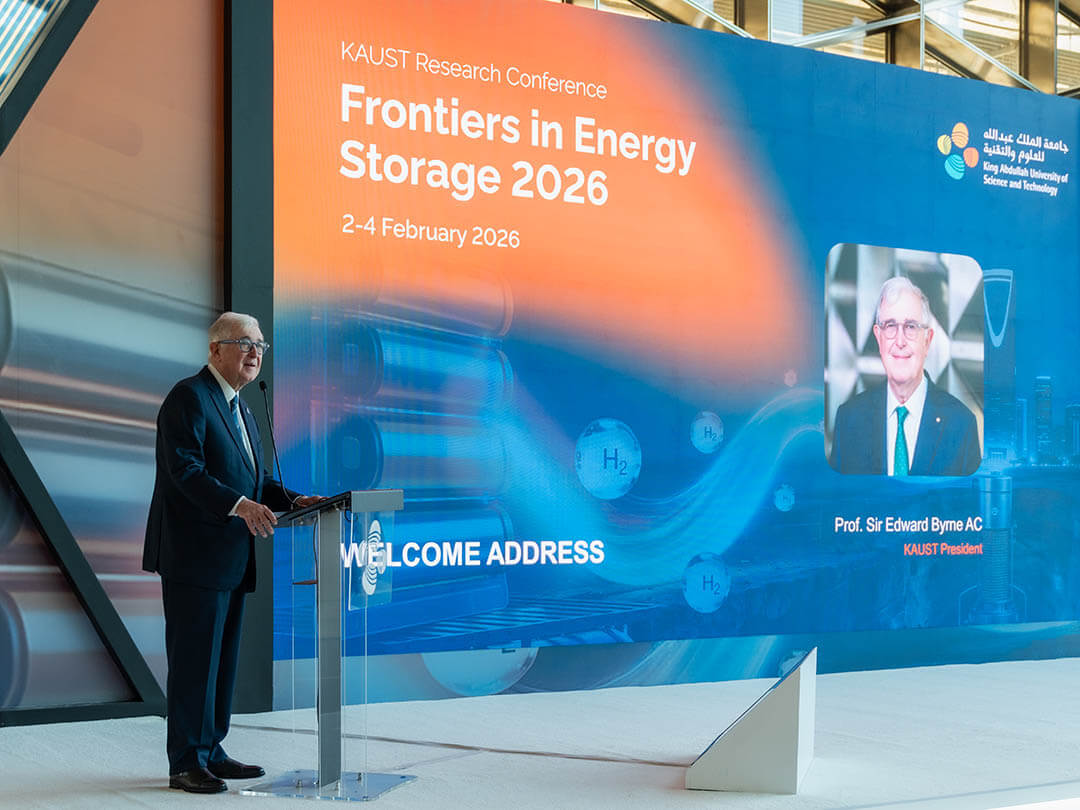
KAUST President Sir Edward Byrne AC delivers opening remarks at the KAUST Research Conference: Frontiers in Energy Storage 2026.
Sir Edward framed the stakes clearly: “Without this level of collaboration, success is impossible. A battery is useless if it cannot connect to the grid. Hydrogen is wasted without storage infrastructure.”
Outlining the future of energy storage
The conference, co-sponsored by Aramco, brought together innovators and industry experts in energy storage from across the Kingdom and around the world, including leading scientists such as Tao Zhang, a member of the Chinese Academy of Sciences and a Clarivate Citation Laureate known for foundational advances in single-atom catalysis.
His presentation outlined how single-atom catalysis — the precise engineering of reaction dynamics using individual metal atoms — has evolved from a foundational scientific concept into a powerful platform for energy conversion and storage, enabling more efficient catalyst design and opening new pathways for industrial-scale, AI-guided innovation. “It is clear that single-atom catalysis has become the most active topic in catalysis,” Zhang said.
Complementing this focus on fundamental materials was a call for pragmatic scaling from the University of Chicago Liew Family Professor Shirley Meng, who directs the U.S. Department of Energy-funded Energy Storage Research Alliance. Meng argued that the climate crisis demands we move beyond replacing conventional batteries to expanding the performance envelope of what batteries can do.
“The race for the better batteries is against the climate crisis — it’s not against each other amongst nations,” she said. “We are actually all breathing the same air.”
Hussam Qasem, general manager of the Future Energy Technologies Institute at King Abdulaziz City for Science and Technology (KACST), said the value of KAUST’s conference lay in convening researchers and decision-makers to align science, industry, and national strategy. “It’s actually a great accelerator.”
Energy innovation requires champions
For industry and policymakers, the message of Frontiers in Energy Storage speakers was clear: long-term investment frameworks, infrastructure planning, and mechanisms that carry innovations through to deployment are essential.
On hydrogen, a critical barrier to large-scale deployment is the gap between promising academic research and real-world application, said Peter Strasser, chair professor of electrochemistry at the Technical University of Berlin. He noted that many innovations stall at mid-level readiness because follow-on projects, industrial partners, funding, and risk appetite are missing. “It takes someone to take the lead in this.”
In response to this challenge, government entities such as King Abdullah City for Atomic and Renewable Energy (KACARE) are stepping in to de-risk these technologies.
By supporting projects from early research through to full deployment, KACARE acts as the bridge between scientists and the commercial industrialization sector, helping promising technologies move beyond the point at which many research efforts typically stall, said Anas Aljambi, director of hydrogen technologies and energy storage systems at the agency. “This is our role — to bridge the gap between scientists and the commercial industrialization sector.”
The energy-storage innovation pipeline
KAUST’s leading translational research was on full display for conference attendees, with several University-developed and owned prototypes showcased to link deep materials science to tangible performance gains. Projects spanned batteries, flow batteries, extraction membranes, and recycling, addressing high temperatures and voltages, aqueous environments, and long-duration cycling, with a strong emphasis on in-Kingdom challenges.
One standout project tackled the digital vulnerabilities in energy infrastructure, examining stealthy cyber-physical attacks on grid-connected inverters and analyzing controller-parameter manipulation to strengthen monitoring and detection in modern power grids.
In a separate line of research, Professor Anqi Wang, an assistant professor of chemistry, whose research focuses on the molecular design and engineering of advanced membranes for redox flow batteries, said KAUST is improving selectivity, stability, and scalability for long-duration energy storage applications. “We’re developing some thermally resistant flow battery systems based on some non-critical metal ions, organic molecules, and advanced membranes.”
In the area of hydrogen systems, KAUST Professor Mani Sarathy, chemical engineering, said KAUST researchers are increasingly applying artificial intelligence to accelerate materials discovery and improve system performance.
Fine-tuned large language models can predict electrocatalyst and membrane behavior, he added, and reinforcement learning is starting to transform how hydrogen systems are controlled and operated in industrial settings. “As engineers in physical domains, we have to work with the experts in AI to really translate these methods and apply them.”
Collectively, Frontiers in Energy Storage 2026 successfully aligned scientific advances with the industrial needs of Saudi Vision 2030, creating a roadmap for a deployable, climate-ready energy ecosystem.