

The right path: New dean Professor Omar Knio focuses on people, purpose, and impact
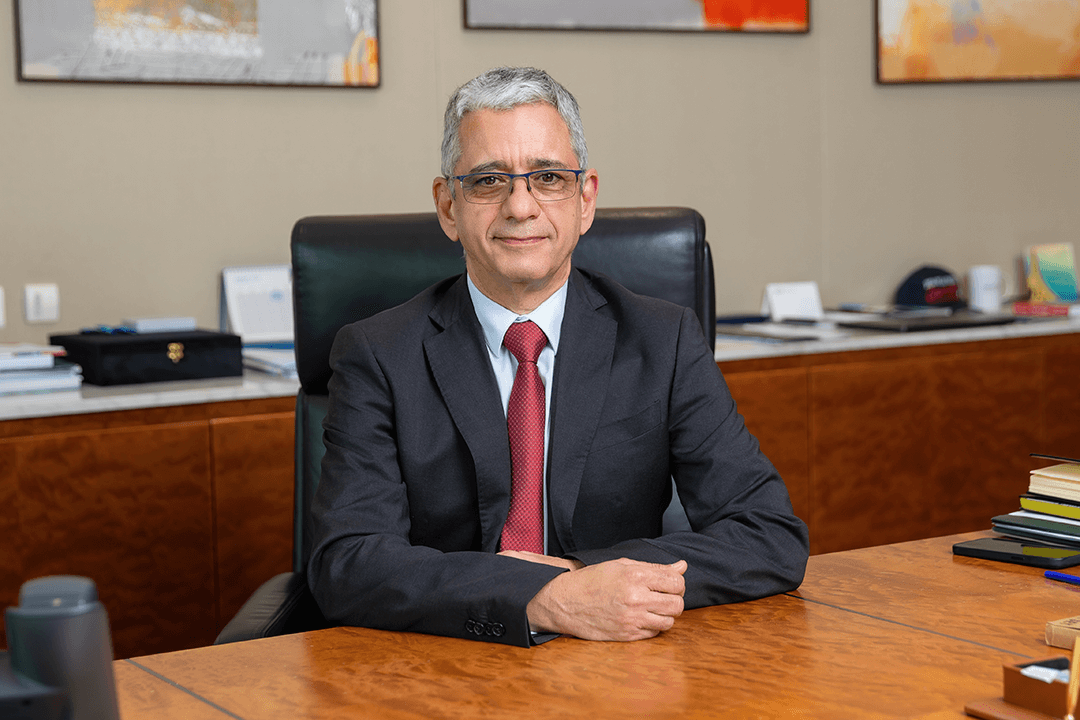
Professor Omar Knio is the newly appointed dean of the Computer, Electrical and Mathematical Sciences and Engineering Division at KAUST.
The life of Professor Omar Knio, recently appointed dean of the Computer, Electrical and Mathematical Sciences and Engineering Division at King Abdullah University of Science and Technology (KAUST), could have taken many different paths.
As a young student, three distinct subjects competed for his attention as he considered what to pursue after high school: mechanical engineering, mathematics, and French literature.
“In another world, I could have been a French professor or a mathematician,” Knio said.
Instead, he chose mechanical engineering, completing his bachelor’s and master’s degrees before earning a Ph.D. at the Massachusetts Institute of Technology. He built an academic career that included appointments at Johns Hopkins University and Duke University before joining KAUST.
“Initially, I came to KAUST in response to a call for proposals for a strategic research initiative program,” he said. “Our project was ultimately awarded, and so I engaged with KAUST initially on a part-time basis in 2012 and 2013. Toward the end of 2013, I determined that KAUST was the right environment to continue my work and decided to move to a full-time role.”
Throughout his time at KAUST, Knio has taken on a series of senior leadership positions that reflect both his academic breadth and institutional experience. These include serving as deputy director of the Strategic Research Initiative Center for Uncertainty Quantification in Computational Science and Engineering and as associate vice president for national partnerships, engagement, and academic liaison at the National Transformation Institute.
He currently serves as vice president of academic affairs.
Knio’s recent appointment as dean of the Computer, Electrical and Mathematical Sciences and Engineering Division follows the departure of Professor Gianluca Setti. It is a familiar role for the applied mathematics and computational sciences professor, who previously served as the division’s interim dean.
“It’s really an opportunity to lead a team that I have grown to appreciate and enjoy working with for a long period of time,” Knio said. “It’s also a tremendous privilege to be leading several key initiatives that are central to KAUST’s strategic mission.”
For now, Knio said he is enjoying both roles — as dean of the division and vice president of academic affairs. Several initiatives remain priorities for him within the faculty and academic affairs portfolio, including advancing hiring plans and revising procedures to ensure they are fully aligned with KAUST’s refocused strategy.
He added: “When these important objectives are achieved, it would be time to revisit the question of whether the load is manageable or whether the academic affairs role would be better entrusted to somebody else.”
KAUST’s strategic direction
As dean, Knio said he aims to strengthen KAUST’s position as an outstanding destination for research, as well as its mission-driven role as a “go-to partner” in Saudi Arabia for developing key initiatives that address national priorities.
Work that spans the University’s divisions and centers of excellence remains essential, Knio added, along with partnerships involving ministries, industry, and other research institutions across the Kingdom and internationally.
“This will take a central role in our refocus strategy because the areas of specialty that are centered in the division, specifically artificial intelligence, data science, high-performance computing, sensing, and communications, are really enablers for all the other key missions.”
For Knio, the division’s strengths underpin nearly every major mission KAUST is pursuing. Modern energy systems, he noted, are inconceivable without computational science and engineering, as are advances in precision medicine, controlled-environment agriculture, and water desalination and reuse.
“Interdisciplinary collaboration is key to delivering on the University’s aspirations.”
Talent development matters
Knio sees his deanship as a continuation of his predecessor’s significant efforts, aimed at delivering on the University’s aspirations and translating ongoing research endeavors at KAUST into real-world solutions.
“An important part of that is making sure we continue the development of our students, faculty, and staff, that we retain the people we have, and that we recruit the next generation of talent,” Knio said. Strengthening the Kingdom’s skilled workforce pipeline, including cultivating more Saudi expertise in support of national localization goals, will continue through well-established avenues.
“First of all, we need to structure our efforts internally in the right way. We have to develop our strategic plans, and we must build the partnerships that will help us deliver on those plans at pace and at scale.”
Invested in KAUST’s future
Knio remains engaged and invested in KAUST due to the progress he has witnessed since first joining the University in 2012. In its early years, the emphasis was on establishing the academic enterprise and building a reputation for research excellence — a goal he said has been overwhelmingly achieved.
“What keeps me most focused and excited, both personally and institutionally, is the opportunity to contribute to the University’s transformation into a mission-focused, mission-led institution and a national asset.”
For the new dean, legacy is not defined by titles, but by teams. It is about connecting experts and stakeholders to sustain excellence in research and education, while preparing science and innovation leaders to meet the Kingdom’s ambitions. “It’s hard to meet a challenge without putting the right teams and the right partnerships in place,” he said.
In terms of his own career path, once pulled between engineering, mathematics, and French literature, ultimately Knio followed the people and possibilities that felt right at the time. Those choices led to his many contributions at KAUST, including his appointment as dean. It was one of several paths his life could have taken.
And as the French say, c’est la vie.