Supercomputing & Networking

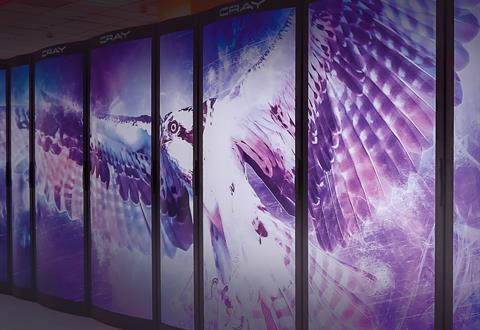
KAUST has partnered with IBM to establish a Supercomputing Research Center. KAUST is hosting the Shaheen supercomputer, named after the Arabian falcon famed for its swiftness of flight. This 16-rack IBM Blue Gene/P system is equipped with 4 gigabyte memory per node and capable of 222 teraflops, making KAUST campus the site of one of the world’s fastest supercomputers in an academic environment. KAUST is targeting petaflop capability within 3 years.

Advance Computation & Visualization Facility

KAUST’s advanced IT infrastructure will include ubiquitous wireless and wired connectivity, with a 40 Gbps backbone and multiple 10 Gbps connections between campus buildings. Abundant dark fibre is ready to be activated when needed. KAUST will also be connected to the world’s IT networks, eventually running at 10 Gbps directly to Internet2 and GEANT2.

High-performance storage and networking subsystems support the capability of Shaheen :

  • Multiple storage building blocks providing a total of 1.9 Petabytes of raw capacity and an aggregate bandwidth of 16 Gbps
  • A Linux node x86 Cluster as an auxiliary computational resource for pre- and post-processing, as well as for initial x86 code tests prior to their enablement on Shaheen
  • A high-speed internal network subsystem
  • A high-capacity archiving subsystem to assure data resiliency and system backup
  • More than 65,600 independent processing cores, tightly coupled in a three-dimensional network
  • A next-generation data center that has the scalability to achieve exascale computing requirements

Researchers will have access to :

  • General support, including high-performance computing (HPC) systems management, programming, applications tuning, algorithms, and usage scheduling of Shaheen and peripheral systems
  • Collaboration to provide high-performance computing applications, middleware, library, algorithm support and enablement services
  • Enablement by which users can task Shaheen research staff to develop, enable, port and scale key applications for “grand challenges”
  • HPC program best practice management techniques