

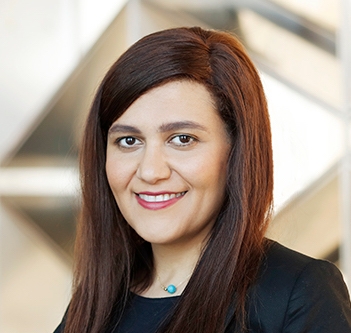
Niveen M. Khashab
Professor, Chemistry
Physical Science and Engineering Division


“Understanding chemical interactions at a molecular level will enable the design and fabrication of smart materialsand coatings that can be used in personalized medicine, sustainable agriculture, and innovative energy solutionssuch as crude-to-chemicals separations.”
Program Affiliations
Center of Excellence
Biography
KAUST founding member Niveen M. Khashab is a world expert in the field of chemicalscience and engineering, recognized for her contributions in bioengineering andnanomaterials. She helped establish the Chemistry Program within the PhysicalScience and Engineering Division (PSE) when she joined the university in 2009. Shealso serves as the associate dean of students, PSE. Dr. Khashab holds multiplepatents, and has received numerous accolades and distinctions for her researchinventions, notably for designing innovative smart hybrid materials aimed at drugdelivery, and developing a new technology to observe antioxidant activity betweencells. Khashab is active in her professional network, among them as a member of theAmerican Chemical Society, Fellow of the Royal Chemical Society and Founder-Director of WISE, an initiative designed to inspire female students to pursue careers inscience and engineering across academia, the corporate sector and government.
Research Interests
Professor Khashab’s current research focuses on intrinsically porous materials (IPMs) for energy intensive separations and supramolecular assembled capsules (SACs) for encapsulation, delivery and biomedical applications. Inspired by the model of evolutionary biological systems, the Khashab team is engaged in the design and synthesis of supramolecular assemblies at the nanoscale employing non-covalent and coordination interactions. They aim to develop systems that can be triggered on demand using self-assembly and supramolecular tools, with the ultimate goal to improve the biomedical outcome of stimuli-responsive platforms by increasing selectivity and the ability to target specific tissues or organs.

Education Profile
Postdoctoral Fellow, University of California Los Angeles, 2007-2008;Northwestern University, USA, 2008-2009
Ph.D. Organic Chemistry, University of Florida, USA, 2007
B.Sc. Chemistry, American University of Beirut, Lebanon, 2002
Awards and Recognitions
Publications
Research Areas
- Chemical Science